 NGN
 KES - Kenya
 UGX - Uganda
 TZS - Tanzania
 RWF - Rwanda
 ZAR - South Africa
 USD - Zimbabwe
 GHS - Ghana
 ETB - Ethiopia
 ZMW - Zambia
 USD - International

Every lender has a checklist, and every checklist looks different. A commercial bank, a microfinance bank, a cooperative and a fintech lender in Nigeria will all ask for documents in their own format. Behind the paperwork, though, they are trying to answer the same five questions, which credit officers often call the “five Cs”: character, capacity, capital, collateral and conditions.
If you understand what each question is really asking, you can prepare records that answer it, whichever lender you approach. This guide goes through them one by one. Lenders set their own rules and make their own decisions, so use it to prepare, not as a promise of approval.
Character: can we trust you?
The lender wants to know who you are, whether the business is real and how you have handled credit before.
Records that answer it:
- Valid means of identification and your BVN for each director or owner.
- CAC registration documents: certificate of registration for a business name, or for a company the certificate of incorporation and the current status report showing directors and shareholders.
- Your business address, with a utility bill or tenancy agreement.
- A clean credit history. Lenders check credit bureau records, so repay existing loans and supplier credit on time.
- Tax registration: your business TIN, and a tax clearance certificate where the lender asks for one.
Capacity: can the business repay?
This is the most important question, and the one most applications answer badly.
Records that answer it:
- Bank statements for the business account, usually covering several months. Statements in the business’s own name, with customer receipts and supplier payments clearly visible, carry far more weight than a personal account full of family transfers. Our guide to separating business and personal money in Nigeria explains how to get there.
- Financial statements: profit and loss and balance sheet for recent years, prepared by an accountant for larger loans.
- Management accounts since the last year-end, showing current trading.
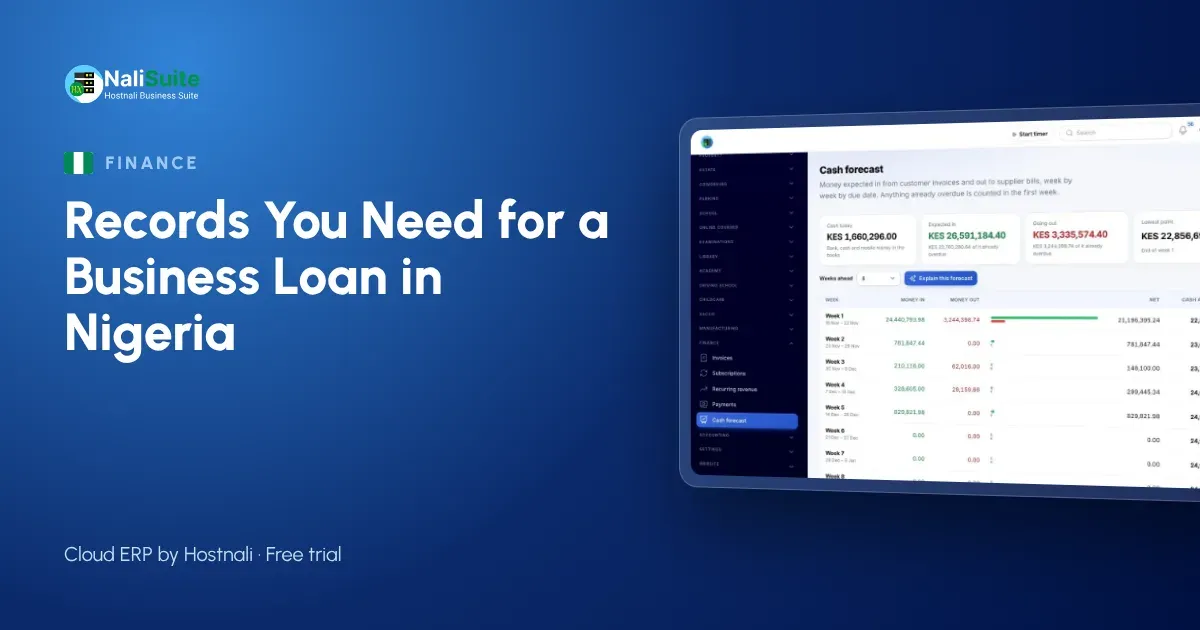
- A cash flow forecast for the loan period showing how repayments fit.
A lender reading your profit and loss statement looks at gross margin, operating profit and whether that profit can cover the new repayment as well as existing ones.
Capital: how much of your own money is in it?
Lenders feel more comfortable when the owner has a real stake in the business.
Records that answer it:
- The balance sheet, showing assets, liabilities and owner’s equity.
- Evidence of money you have invested, such as transfers into the business or assets bought.
- Retained profits, which show the business has been building value rather than paying everything out.
Collateral: what if things go wrong?
Some loans need security; others rely on cash flow alone.
Records that answer it:
- Documents for assets offered as security: property papers, vehicle papers or equipment invoices.
- Guarantor details, where asked.
- An asset register from your accounts, showing what the business owns and its value.
Conditions: what is the loan for, and what is happening around you?
The lender considers the purpose of the loan and the market you trade in.
Records that answer it:
- A short written purpose: what you will buy, why, and what it will earn.
- Quotations or pro-forma invoices for equipment or stock.
- Contracts, purchase orders or a list of regular customers that support the expected sales.
- A debtors list showing who owes you, how much and how long they take to pay.
An example: Emeka’s printing press in Lagos
Emeka runs a printing business in Surulere and wants to finance a new digital press. His first attempt at a loan stalled: his statements were in his personal name, his accounts were two years old and he had no forecast.
For the second attempt he prepared:
| Question | Emeka’s records |
|---|---|
| Character | CAC documents, IDs, TIN, tax clearance, clean repayment history on a previous equipment loan |
| Capacity | Business account statements, monthly management accounts, a cash flow forecast with the new press |
| Capital | Balance sheet showing equipment he already owns and retained profit |
| Collateral | Invoice and specifications for the press, which the lender could hold as security |
| Conditions | Purchase orders from three regular corporate clients |
The application was assessed in a fraction of the time, because the lender’s questions were answered before they were asked.
Keeping records ready all year
Preparing a loan pack is slow when the records live in notebooks and spreadsheets. In NaliSuite Accounting, every invoice, bill, payslip and payment posts to the books as it happens, so profit and loss, balance sheet and cash flow statements are ready at any time. Invoicing keeps an aged debtors list, bank reconciliation shows the books agree with your statements, and Documents stores CAC papers, tax certificates and contracts to share securely with a lender.
Frequently asked questions
Do I need a corporate account to get a business loan?
Lenders generally prefer statements in the business’s name. A dedicated account makes your sales and costs much easier to assess.
How far back should my statements go?
It depends on the lender and the loan. Ask before you apply, and keep at least a year of clean records.
Do I need audited accounts?
Smaller loans are often assessed on statements and management accounts; larger ones more often require accountant-prepared or audited accounts.
Will good records guarantee approval?
No. They make your application easier to assess and show the lender a clear picture of the business.
Try NaliSuite
Keep your records loan-ready every month. NaliSuite starts at ₦3,125 a month with a free trial. See the plans.