 NGN
 KES - Kenya
 UGX - Uganda
 TZS - Tanzania
 RWF - Rwanda
 ZAR - South Africa
 USD - Zimbabwe
 GHS - Ghana
 ETB - Ethiopia
 ZMW - Zambia
 USD - International

Ask most Nigerian traders how business went last month and they will answer by looking at their bank app. Naira in the account went up, so business was good. Naira went down, so it was bad. The trouble is that the balance moves for many reasons that have nothing to do with profit: a customer paying an old debt, a loan disbursement, school fees taken out, or a large stock purchase ahead of the festive season.
The profit and loss statement (P&L) strips that noise away. Rather than reading it as a list of accounting lines, read it as answers to four questions.
Question 1: Did the business actually make money?
Start at the bottom line, net profit, then work upwards to see how you got there. A P&L for a period, say October, shows:
- Revenue: everything you sold or invoiced in October, whether the customer has paid yet or not.
- Cost of sales: what the goods or materials you sold in October cost you.
- Operating expenses: rent, salaries, diesel for the generator, internet, transport, bank and POS charges, marketing.
- Finance costs and tax: interest on loans and your income tax charge.
- Net profit: what is left for the owners.
If net profit is positive, the business earned more than it consumed in that month. If it is negative, the business is shrinking your capital, even if the bank balance looks healthy for now.
Question 2: Where is the money going?
Once you know the bottom line, look at the shape of the costs. Two percentages tell you most of the story.
Gross margin is gross profit (revenue minus cost of sales) divided by revenue. It shows how much of each sale is left after paying for the product itself.
Expense ratio is operating expenses divided by revenue. It shows how heavy the business is to run.
Picture Chidi, who distributes beverages to shops in Onitsha. His gross margin is steady at around 18%, but his expense ratio has crept from 11% to 15% over six months. The P&L shows why: diesel for the generator and delivery fuel both rose sharply, and he added a second truck on a route that does not yet sell enough to carry it. Nothing about his pricing changed. His problem is on the cost side.
Now picture Amaka, who sells fabrics and ready-made clothes in Aba. Her expenses are flat, but her gross margin fell from 35% to 27%. She has been giving bigger discounts to wholesale buyers and her supplier’s prices rose with the exchange rate, but her shelf prices did not. Her problem is on the margin side.
Same symptom, a lower profit, but two different cures. The P&L is how you tell them apart.
Question 3: Is it getting better or worse?
A single P&L is a snapshot. The value comes from comparing it:
| Compare | What it shows |
|---|---|
| This month vs last month | Sudden changes worth investigating now |
| This month vs same month last year | Seasonal effects, such as December demand or the rainy season |
| Year to date vs budget | Whether the plan you made is still realistic |
When prices move quickly, as they often do in Nigeria, look at volumes as well as naira figures. Revenue up 20% with prices up 25% means you actually sold less.
Question 4: What should I do about it?
Every line that moved deserves a decision:
- Margin down? Check your price list against your latest supplier invoices. Update prices or renegotiate.
- One expense jumped? Find the invoices behind it. A single unusual bill is different from a cost that is now permanently higher.
- Revenue flat? Look at which customers bought less than usual and call them.
- Profit good, cash poor? Your customers may be paying late. Chase overdue invoices before you borrow.
Reading the lines you are likely to misread
- Depreciation. When you buy a generator or a delivery van, its cost is spread over its useful life. The P&L shows a slice each month rather than the full price.
- VAT. VAT you charge customers is not your revenue; it is collected on behalf of the Nigeria Revenue Service (NRS), which took over from FIRS. Check the current rules with NRS or your accountant.
- Owner’s money. Money you put into the business is capital, not revenue. Money you take out for yourself is a drawing, not an expense, unless you pay yourself a salary through payroll.
- Exchange gains and losses. If you import or hold dollars, movements in the exchange rate can appear as a separate line. Keep them apart from trading profit so you can see how the business itself performed.
Getting the numbers without a spreadsheet
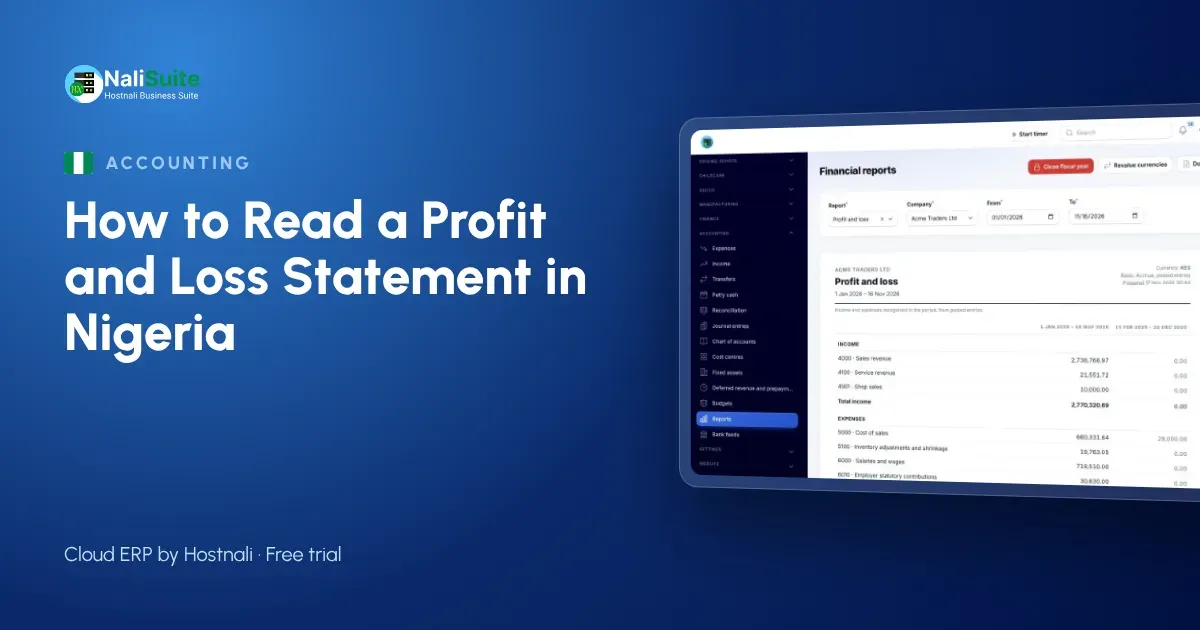
The hardest part of the P&L for most small businesses is not reading it but producing an accurate one every month. NaliSuite Accounting posts every sale, supplier bill and payslip to the books as it happens, so the profit and loss statement, balance sheet and cash flow statement are ready at any time, with the previous period alongside. Invoices from Invoicing and supplier bills from Purchases flow in without retyping, and bank reconciliation matches your bank statement to the books so missing or duplicated entries stand out.
Frequently asked questions
Why does my P&L show a profit when I have no money?
Profit counts sales when they happen, not when customers pay. Stock purchases, loan repayments and drawings also reduce cash without appearing as expenses. Read the P&L together with a cash flow statement.
Do I need an accountant to read a P&L?
No. You need to understand revenue, cost of sales, expenses and margin, which this guide covers. An accountant is still valuable for tax, year-end and audits.
How do I handle sales paid by POS transfer or bank transfer?
Record them as sales when made, and match each payment to its invoice when it arrives. Charges deducted by the bank or POS operator are an expense.
What period should my P&L cover?
Monthly for management, yearly for your tax return and annual accounts.
Try NaliSuite
See your profit and loss statement update itself every day. NaliSuite starts at ₦3,125 a month with a free trial. Compare the plans.