 NGN
 KES - Kenya
 UGX - Uganda
 TZS - Tanzania
 RWF - Rwanda
 ZAR - South Africa
 USD - Zimbabwe
 GHS - Ghana
 ETB - Ethiopia
 ZMW - Zambia
 USD - International

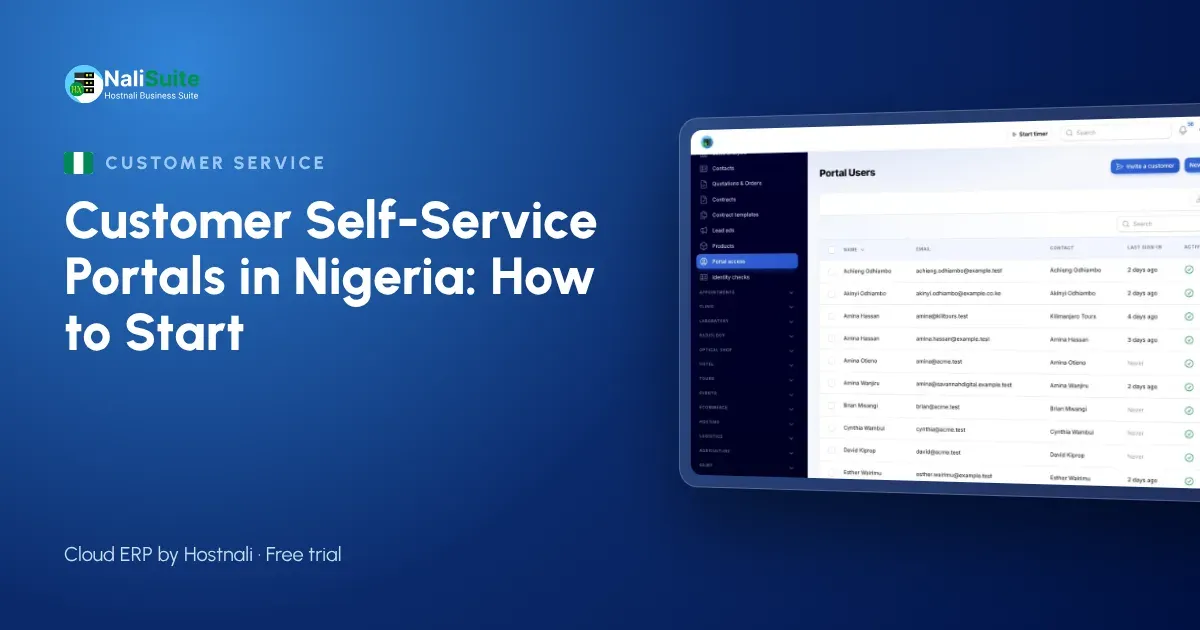
Picture a procurement officer at a manufacturing firm in Ikeja. Her finance director wants a statement of account by Friday, a supplier invoice from March has gone missing, and she needs to know whether last week’s order has been dispatched. Today she sends three emails and makes two calls to your office. With a portal, she logs in once and finds all three answers herself.
That is the promise of a customer self-service portal. Below we follow a customer through one, then set out a four-week plan for Nigerian businesses that want to launch theirs.
A customer’s visit, step by step
Let’s call our procurement officer Ngozi. This is what her visit looks like in the NaliSuite customer portal:
- She signs in with her work email and a secure link. No new app to install; the portal opens in her browser.
- She lands on her company’s account, and only her company’s. Other customers’ records are invisible to her.
- She downloads the statement her director asked for, with every invoice and payment for the period.
- She finds the March invoice and pays it online by card or bank, through your payment provider. The payment is recorded against that invoice automatically.
- She checks the order that was quoted last week, which she accepted online, and sees where it stands.
- She opens a ticket about a damaged carton, attaches a photo and follows the reply in the same place.
Nobody in your office had to stop what they were doing.
The features behind that visit
| Customer need | Portal feature |
|---|---|
| “Send me our statement” | Invoices and statements, downloadable any time |
| “How do I pay?” | Online payment of outstanding invoices |
| “Is the quote still valid?” | Quotations reviewed and accepted online |
| “Where is my order?” | Orders followed after acceptance |
| “Something went wrong” | Support tickets and knowledge base |
| “Please send the contract” | Shared documents and online signatures |
Access is by invitation: you invite customer contacts by email, and each sees only their own organisation’s records. Read more about online payments in NaliSuite, which work with providers such as Paystack and Flutterwave.
A four-week rollout plan
Week 1: get the records ready
Check that every active customer has a correct email, phone number and TIN on file, and merge any duplicates. Make sure open invoices are accurate, because customers will now see them directly.
Week 2: pilot with a friendly group
Choose a handful of customers who already pay electronically and invite their accounts contacts. Ask them to try three tasks: download a statement, pay an invoice and open a ticket. Note every question they ask.
Week 3: write the help articles
Turn those questions into short knowledge base articles, published in the helpdesk help centre and shown in the portal. Keep each article to one task with a few screenshots.
Week 4: launch to everyone
Invite all active customers. Add the portal link to your invoice footer, email signature and statements, and tell your team to point customers there rather than emailing PDFs.
Mistakes that slow adoption
- Inviting the wrong person. Invite the people who handle payments and orders, not only the managing director.
- Inaccurate balances. If the first statement a customer sees is wrong, trust drops quickly. Reconcile before you launch.
- Keeping the old habit. If staff keep emailing invoices on request, customers never learn to use the portal.
- No reason to log in. Make online payment the easiest way to settle an invoice, and customers will come back.
Which Nigerian businesses gain most
A portal pays off fastest where the same customers buy repeatedly and ask about money often:
- Distributors and wholesalers in Lagos, Onitsha or Kano, whose trade customers order weekly and settle on credit.
- Service firms such as IT support, cleaning or logistics companies billing monthly retainers.
- Schools and training centres whose parents or sponsors want fee statements without queuing at the bursary.
- Property managers in Abuja or Port Harcourt sending service charge invoices to tenants.
If most of your customers buy once and never return, a portal matters less than a clear invoice and an easy payment link.
Data protection in Nigeria
Customer contact details and statements are personal data under the Nigeria Data Protection Act 2023, enforced by the Nigeria Data Protection Commission (NDPC). Only invite contacts the customer has authorised, remove access promptly when people move on, and keep sensitive documents to the customers who need them. Check current NDPC guidance for any obligations specific to your business.
Frequently asked questions
Does the customer portal cost extra?
No. It is included in every NaliSuite plan, starting from ₦3,125 a month for Starter.
Can a customer have more than one login?
Yes. You can invite several contacts from the same customer, and each sees that organisation’s records.
Can customers pay by bank transfer instead?
They can always pay you the usual way. Online payment in the portal is simply the fastest route, because it links the payment to the invoice.
Will the portal show our brand?
Yes. On plans with a custom domain, or with the custom domain add-on, the portal can run on your own domain.
Try NaliSuite
Let your customers find statements, pay invoices online and follow their orders themselves. See the NaliSuite plans and start a free trial, or read about invoicing in NaliSuite first.