 NGN
 KES - Kenya
 UGX - Uganda
 TZS - Tanzania
 RWF - Rwanda
 ZAR - South Africa
 USD - Zimbabwe
 GHS - Ghana
 ETB - Ethiopia
 ZMW - Zambia
 USD - International

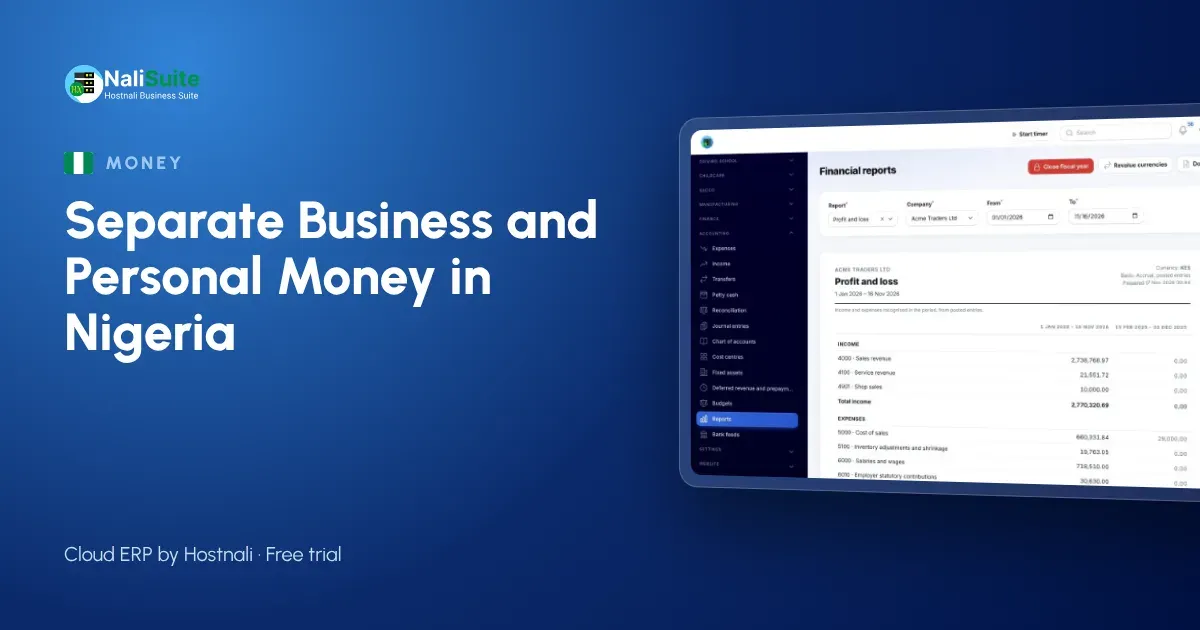
“Business is my life” is a common saying among Nigerian entrepreneurs, and for many it is literally true of their bank accounts. Sales land in the owner’s personal account, diesel and rent go out of it, and so do family support, church contributions and holiday flights. It works until the day you need to know how the business is really doing, or until a bank, an investor or a large customer asks for statements.
Rather than a theory lesson, here are seven signs that your money is mixed, with the fix for each.
Sign 1: Customers pay into your personal account
If buyers transfer to an account in your own name that you also use for private spending, every incoming transfer has to be sorted later.
The fix: open a corporate account for a registered company, or a dedicated account for a registered business name, and print it on every invoice and receipt. Registration is done with the Corporate Affairs Commission (CAC), and banks will ask for your CAC documents and TIN when you open the account. Stop sharing your personal account details with customers.
Sign 2: Your POS terminal settles to a personal account
Many shops took a POS terminal quickly, linked to whichever account was handy.
The fix: ask your provider to settle to the business account. If you also take payments online through a provider such as Paystack or Flutterwave, make sure those settle to the business account too.
Sign 3: You cannot say what you paid yourself last month
If the answer is “whatever I needed”, the business is paying for your life without a record.
The fix: set a fixed amount and a fixed day. Sole proprietors and partners take drawings, a transfer from the business account to the personal account. Directors of a limited company can take a salary through payroll with the statutory deductions; NaliSuite’s PAYE payroll works them out. Your accountant can advise on the right mix for your situation.
Sign 4: Family costs are paid straight from the business
School fees, house rent, generator fuel at home and relatives’ requests often come straight out of the business account.
The fix: pay them from your personal account, funded by your pay. If the business must help one month, record a loan to the owner and repay it.
Sign 5: Receipts live in a drawer, or nowhere
Without receipts, nobody can tell a business cost from a personal one, and the costs you cannot support are a weakness at tax time.
The fix: record each business cost with its invoice or receipt attached. In NaliSuite Purchases, you can photograph a supplier bill and Document AI fills in the supplier, lines and tax for you to check. Contracts and other papers can sit in Documents.
Sign 6: The month-end balance surprises you
If you only discover a problem when the balance is low, nobody is checking the statement line by line.
The fix: reconcile weekly. Import the bank statement, match each line to a sale, a bill, a transfer or your drawings, and question anything unexplained. NaliSuite’s bank reconciliation suggests matches automatically.
Sign 7: Your accountant spends days “sorting things out”
Paying an accountant to separate personal and business transactions is expensive, and every guess they make is a risk.
The fix: once signs 1 to 6 are fixed, your accountant receives clean books and can spend their time on tax planning instead.
A worked example: Funke’s catering business in Ibadan
Funke caters for weddings and corporate events. Clients pay deposits and balances into her personal account, and she buys food, gas and hires staff from it too. In the busy December season the account swells; in February it is nearly empty, and she cannot tell whether the season was profitable.
Her changes:
| Area | New rule |
|---|---|
| Client payments | Invoices show the business account only; deposits recorded against each event |
| Event costs | Bought from the business account; receipts photographed the same day |
| Staff for events | Paid from the business account, with the event name in the narration |
| Funke’s pay | A fixed transfer on the 28th of each month, recorded as drawings |
| Review | Statement reconciled every Monday |
After one season she can see the profit on each event. Two corporate clients turn out to be her best earners; one large wedding package lost money once staff and transport were counted. She revises her packages accordingly.
Do you need to register first?
You can start separating money before you register, by using a dedicated account only for the business. But a registered business with a corporate account looks more credible to customers and lenders, and makes the line between you and the business clear. Ask CAC or your accountant which structure fits.
Frequently asked questions
Can I use my personal account for business if I keep good notes?
It is possible but fragile. A dedicated account removes the guesswork and is far easier to reconcile.
Are drawings a business expense?
No. They are profit taken out by the owner. They do not reduce taxable profit.
What about cash sales?
Bank cash takings into the business account regularly, rather than spending them, so every sale appears on the statement.
How does separation help with loans?
Lenders read your statements. Clean ones show what the business earns; see our list of records for a business loan in Nigeria.
Try NaliSuite
Keep the business on its own books with NaliSuite Accounting, from ₦3,125 a month with a free trial. See the plans.