 NGN
 KES - Kenya
 UGX - Uganda
 TZS - Tanzania
 RWF - Rwanda
 ZAR - South Africa
 USD - Zimbabwe
 GHS - Ghana
 ETB - Ethiopia
 ZMW - Zambia
 USD - International

Ask small business owners in Nigeria what keeps them awake and many will say the same thing: customers who pay late while suppliers want money up front. Add rising input costs and an unpredictable exchange rate, and cash flow becomes the real test of a business, more than sales.
Where the cash goes missing
Before fixing cash flow, find the leaks. In most small businesses they are:
- Credit given too freely, to customers who were never asked for terms.
- Stock bought too early, often in bulk to beat a price rise, then sitting unsold.
- Invoices sent late, sometimes weeks after delivery.
- Tax not set aside, so VAT and PAYE remittances arrive as a shock.
Practical fixes
Put terms in writing
Every credit customer should know the due date before they receive goods. Print it on the invoice and confirm it in your first email or WhatsApp message.
Invoice on delivery, chase on the due date
The sooner the invoice goes out, the sooner it is paid. Send a reminder the day an invoice falls due, and a firmer one a week later. NaliSuite Invoicing sends both for you.
Make paying easy
Customers pay faster when they can pay from the invoice. A pay link for card and bank transfer, connected to your own online payments account, removes the excuse.
Buy for demand, not for fear
Stocking up ahead of a price rise can make sense, but only for items that sell quickly. Check sales history before a big purchase.
Ring-fence tax
Move VAT and PAYE into a separate account as you collect them. When the State IRS or the NRS deadline arrives, the money is already there.
Know your numbers weekly
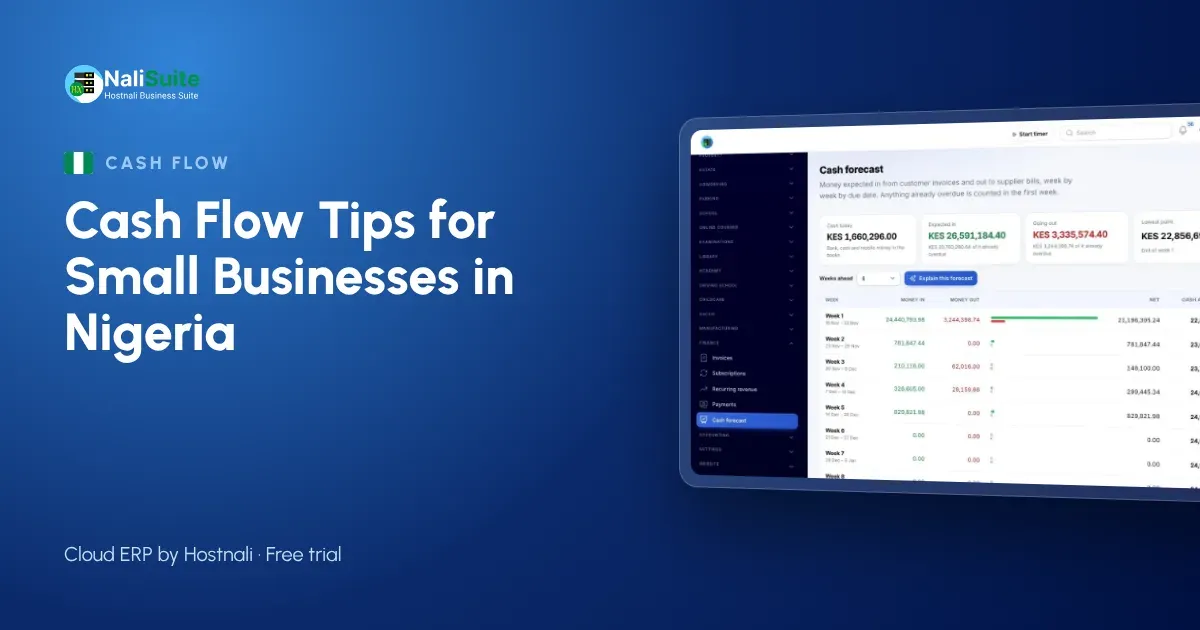
A quick weekly review of three figures (cash available, money owed to you, money you owe) tells you more than any monthly report. Reconciling your payments each week keeps those figures accurate.
Plan the next three months
Write down the receipts you expect and the payments you must make, week by week. Where the balance turns negative, act early: collect a large debt, stagger a supplier payment or arrange finance while you still have options.
When to consider short-term finance
Even with good habits, a large order can need more cash than the business has. Before borrowing, check the cost of the loan against the margin on the order, confirm the customer’s payment record, and make sure the repayment date falls after the customer’s due date. Finance arranged early, with a forecast in hand, is usually cheaper and easier to get than finance requested in a crisis.
A second example: an Enugu bakery
A bakery in Enugu supplies supermarkets on credit and sells over the counter for cash and transfer. Flour prices kept rising, so the owner bought months of flour at once, leaving little cash for salaries. The fix was simple: buy flour monthly against confirmed orders, ask the two largest supermarkets for 14-day terms instead of 30, and put over-the-counter takings into a separate account used only for wages. Salaries have been paid on time ever since.
A weekly cash checklist for Nigerian businesses
- Cash available across all bank accounts today.
- Invoices due this week and next, with reminders sent.
- Overdue invoices, with a named person to call.
- Supplier payments due in the next two weeks.
- VAT and PAYE set aside for the next remittance.
- Any large purchase checked against the forecast before approval.
Putting it into practice in Nigeria
Start with your debtors. Sort every unpaid invoice by age and call the oldest customers first; a friendly call often recovers money that a month of emails did not. Next, look at stock: walk the store with your sales report and list anything that has not sold in three months. Stop reordering those lines and consider clearing them at cost, because cash in the bank is worth more than stock gathering dust. Finally, open a separate account for VAT and PAYE and move this month’s amounts into it today, so the next remittance date is a non-event.
How Nigerian owners use NaliSuite for cash flow
NaliSuite Invoicing sends invoices with pay links and automatic reminders, Inventory shows slow-moving stock across stores, and Accounting keeps receivables, payables and bank balances in one view, so the weekly review takes minutes.
Frequently asked questions
Should I offer discounts for early payment?
A small discount can bring cash in sooner, but only offer it where your margin allows.
How can I protect cash flow from currency swings?
Avoid holding more imported stock than you can sell quickly, and review prices regularly.
What is the first report I should look at?
The list of unpaid invoices, sorted by how overdue they are.
How do I protect wages when sales are slow?
Set aside a portion of each week’s takings in a separate account for salaries, so payroll never depends on a single large payment.
Should I ask big customers for shorter terms?
It is worth asking. Many will agree, especially if you deliver reliably and invoice promptly.
Try NaliSuite
NaliSuite starts from ₦3,125 a month with invoicing, accounting and inventory included. Compare the plans.