 NGN
 KES - Kenya
 UGX - Uganda
 TZS - Tanzania
 RWF - Rwanda
 ZAR - South Africa
 USD - Zimbabwe
 GHS - Ghana
 ETB - Ethiopia
 ZMW - Zambia
 USD - International

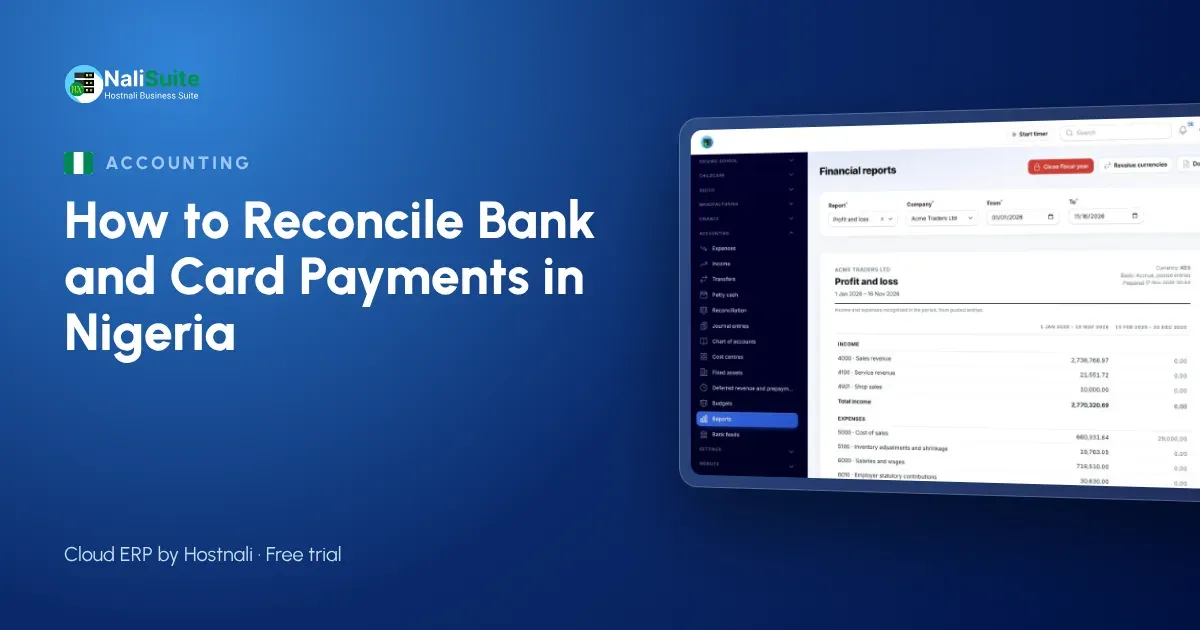
Ask a Lagos retailer how much cash came in last month and you will usually get a quick answer. Ask which customers paid which invoices and the answer takes days. Reconciliation is the discipline of answering the second question properly, every week, by comparing your bank and card statements with your sales records.
Why Nigerian businesses fall behind on it
Payments here come from many directions at once: bank transfers from customers’ apps, card payments through providers such as Paystack or Flutterwave, POS terminals in the shop and the occasional cash deposit. Each channel produces its own statement, often with different dates and references. Without a routine, the records drift apart quietly until a supplier, an auditor or a tax return forces the issue.
A practical method
Line up three sources
Before matching anything, gather your bank statement, your card provider’s settlement report and your list of open invoices for the same period. Settlement reports matter because card money usually lands in the bank as one batch, minus fees, a day or more after the sale.
Match transfers to invoices
Bank transfers are the easiest wins. Look for the invoice number in the narration; where there is none, match on amount and customer name. Mark each matched invoice as paid.
Break settlements back into sales
A single settlement of many card payments must be traced back to the individual sales it contains. Record the provider’s fee as an expense so the net amount in the bank makes sense.
Note what you cannot explain
An unexplained credit might be a customer paying early, a refund from a supplier or a mistake by the bank. Write it down and chase it within the week, while people still remember.
Prove the balance
End by checking that your book balance and the bank balance agree. Any difference means a missing or duplicated entry.
Where the differences hide
- Stamp duty and bank charges deducted on transfers, which are small enough to ignore and large enough to throw the balance off.
- Withholding tax deducted by corporate customers, which leaves an invoice short by a percentage until you record the deduction against it.
- Reversed transfers that appear and disappear on the statement within days.
- Transfers between your own accounts, which are not income and must not be counted twice.
Keeping tax records consistent
The Nigeria Revenue Service is moving businesses onto e-invoicing in phases, and reconciled books make your reported sales easy to support. If you send invoices through FIRS e-invoicing in NaliSuite, your invoices and your receipts start from the same records.
Making it faster
NaliSuite Accounting imports bank statements and suggests the invoice each line pays. Online payments taken through pay links on your invoices close the invoice automatically, so most of the matching is done before you start. For the rest, the reconciliation feature shows suggestions you simply confirm.
A month in the life of an Ibadan distributor
A beverage distributor in Ibadan sells to about sixty outlets. Some pay by transfer from their banking app, some by card at the warehouse POS, and two large supermarkets pay monthly after deducting withholding tax. In week one the owner matches transfers to invoices, noting three without narrations. In week two the POS settlement report shows four days of card sales landing as two credits; each is split into its sales and the provider fee. In week three the supermarket payments arrive short by the withholding amount, which is recorded against the invoices with the receipts filed. By week four, the only open items are two genuinely unpaid outlets, and the owner’s calls that week are short and specific.
A second example: a Kano wholesaler
A textile wholesaler in Kano receives transfers from retailers in several states, many sent from personal accounts rather than business ones. To keep matching simple, the wholesaler gives every retailer a customer code and asks them to put it in the transfer narration with the invoice number. Retailers who forget are matched by amount and date, then reminded by WhatsApp. The wholesaler also keeps a separate account in the books for each bank, so a transfer between two of its own banks shows as one movement out and one movement in, and never as income.
A checklist before you close the month
- Every bank account and payment provider reconciled to the last day of the month.
- Card settlements split into sales and fees.
- Withholding tax deductions recorded against invoices, with receipts filed.
- Stamp duty and bank charges posted.
- Unidentified receipts listed with the follow-up action and who owns it.
- Customer statements sent, so customers can query differences early.
Frequently asked questions
How do I handle withholding tax deducted by a customer?
Record the deducted amount against the invoice as withholding tax, keep the credit note or receipt, and the invoice closes in full.
Should I reconcile each bank account separately?
Yes. Reconcile every account and every payment provider on its own, then check that transfers between them cancel out.
Is weekly reconciliation enough?
For most small businesses, yes. Shops with heavy card traffic often reconcile daily.
How do I treat a transfer from a customer’s personal account?
Match it to the customer’s invoice as normal and, if needed, note the sender’s name on the payment so your records explain it.
What if a POS settlement is missing a day?
Check the provider’s report for that date; settlements can be delayed. Keep it on your list until it arrives.
Try NaliSuite
NaliSuite starts from ₦3,125 a month, with accounting, invoicing and the other built-in apps on every plan. See the plans.