 NGN
 KES - Kenya
 UGX - Uganda
 TZS - Tanzania
 RWF - Rwanda
 ZAR - South Africa
 USD - Zimbabwe
 GHS - Ghana
 ETB - Ethiopia
 ZMW - Zambia
 USD - International

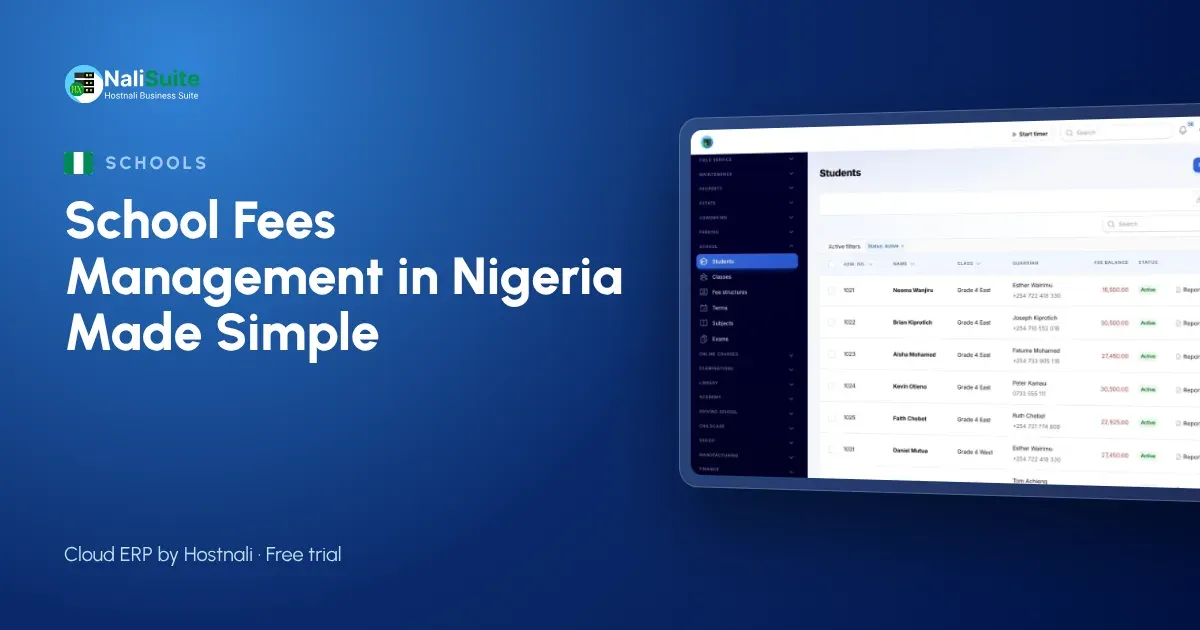
Private schools in Nigeria depend on fees arriving at the start of each term, yet many still reconcile bank transfers by reading alerts one by one.
Here is a cleaner way to run fees from the first invoice to the last reminder.
Example: a nursery and primary school in Abeokuta
A school in Abeokuta with nursery and primary sections billed each section on a different spreadsheet. With fee structures per level, all invoices are raised before resumption, transfers are matched against invoices through bank reconciliation, and the proprietor sees one balance list for the whole school.
Write a fee policy parents can read
A short written fee policy prevents most arguments. State the fees per level, the due dates, whether instalments are allowed and when, how discounts and bursaries are decided, and what happens when a balance is carried into the next term. Share it with every family at admission and attach it to the first invoice of the year. When a parent disputes a balance, the policy and the statement settle it quickly and politely.
Registers, exams and report cards
Fees are only part of a school office’s work. Daily registers, exams and report cards need the same student list, and duplicating it in several files invites errors.
Daily registers are taken per class, marks feed report cards with grades and positions, and the Exams add-on handles clash-free timetables and result analysis. The Customer Portal gives parents a page with their child’s information.
Mistakes that slow fee collection
- Invoicing after term has started. Parents plan around the first invoice they receive.
- Accepting payments without a reference. An unmatched payment is a dispute waiting to happen.
- Hiding discounts in the totals. Record bursaries and sibling discounts as discounts so they can be reviewed.
- One reminder for everyone. Remind early payers less and long-overdue balances more.
- Keeping balances on one person’s computer. If the bursar is away, the school should still know who owes what.
Set fee structures per level, not per child
Most fee confusion starts with one-off arrangements typed into a spreadsheet. Define the fees once for each level or class: tuition, meals, transport, activities. Then every child in that level gets the same items, and only genuine exceptions are handled separately.
In the School Management add-on fee structures are set per level and invoiced to parents each term in one click, with discounts for siblings, staff children or bursaries recorded as discounts rather than hidden in the totals.
Run staff payroll from the same system
A school’s biggest cost is its staff. Running payroll in the same system as fees means the cash position, salary bill and statutory deductions are always visible together.
Payroll produces payslips for teachers and support staff, payout files for the bank and the figures for monthly returns, and posts everything to accounting.
Notes for Nigerian schools
Most Nigerian parents pay school fees by bank transfer or card, sometimes in parts. Ask parents to pay against an invoice with its reference, and reconcile transfers against invoices the same week.
Student and parent information is personal data under the Nigeria Data Protection Act, 2023; restrict access to fee and contact details to the staff who need them.
Send invoices before parents ask
A parent who has to call the office to find out what they owe will pay later than one who already has an invoice. Bill early and give each family one document for each child, with the items, discounts and balance carried forward.
Term invoices are raised from the fee structure in one click and can be sent with a pay link, so paying is a tap on the phone rather than a trip to the bank.
Collect fees without chasing every parent by phone
Phone calls are the most expensive way to collect fees. Most parents pay when reminded at the right time with an easy way to pay.
Parents pay by card or bank transfer through your payment provider; the payment lands on the right invoice without the bursar matching receipts by hand. Balances per student and per class show where to focus, and statements show each family what they have paid this year.
Your first term on a new system
Before term: import students, guardians and opening balances, and set fee structures per level. First week: send term invoices with a pay link so parents can pay by card or bank transfer through your payment provider. Mid-term: send reminders to balances by class. End of term: carry balances forward and review collections against salaries.
Frequently asked questions
Can parents pay by bank transfer?
Yes. Transfers can be reconciled against invoices, and parents can also pay by card through your payment provider.
Can we handle PAYE for staff?
Yes. Payroll works out PAYE and pension for teachers and support staff and produces payslips and schedules.
Is the school module an extra cost?
School Management and Exams are add-ons to any NaliSuite plan, so you pay only for what you use. Plans start from ₦3,125 a month.
Do parents need to install an app?
No. Parents receive invoices with a pay link and can open their page in the portal from any phone browser.
Try NaliSuite
Start with fee structures and invoices this term, and add registers, exams and the parent portal as the office gets used to it. Read more about NaliSuite for schools or see the plans, from ₦3,125 a month with a free trial.