 NGN
 KES - Kenya
 UGX - Uganda
 TZS - Tanzania
 RWF - Rwanda
 ZAR - South Africa
 USD - Zimbabwe
 GHS - Ghana
 ETB - Ethiopia
 ZMW - Zambia
 USD - International

A facility management company in Lekki bills 40 estates every month. A tutoring centre in Ibadan bills parents every term. An IT firm in Abuja bills retainers to a dozen offices. Each one depends on income that should arrive like clockwork, and often does not.
The reason is usually not bad customers. It is a billing process that relies on someone remembering. This guide looks at the problems manual recurring billing causes in Nigerian businesses and how to fix each one.
Problem 1: Invoices go out late
When invoices are prepared by hand, they wait for the person who prepares them. A busy week, a public holiday or a power cut, and the invoices for the 1st go out on the 9th. Customers then pay on their own schedule.
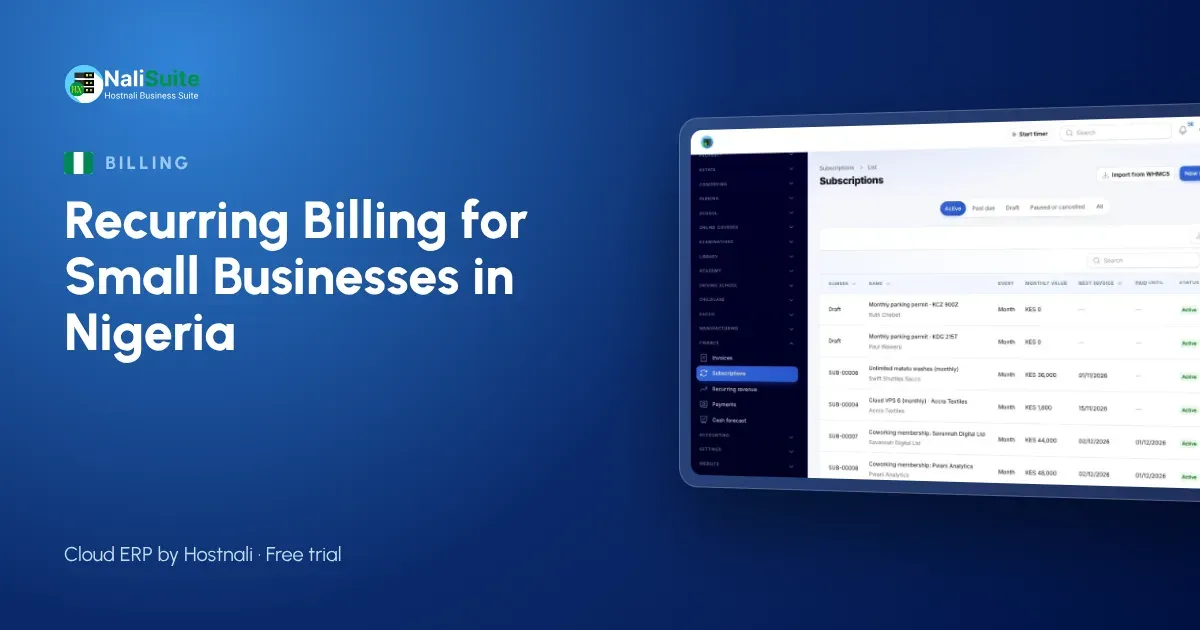
Fix: create invoices automatically. With NaliSuite Subscriptions, you set up each customer’s subscription once (amount, period and start date) and the invoice is created and sent on the right day, every period, by email or WhatsApp.
Problem 2: Transfers that are impossible to match
A customer sends a transfer with the narration “payment”. Three customers pay the same amount on the same day. Your account officer cannot tell you who sent what.
Fix: give every invoice a clear number and ask customers to quote it. Better still, put an online pay link on every invoice, so the payment is tied to that invoice from the start. NaliSuite invoices can carry a link to pay through the provider you connect, such as Flutterwave; see online payments. For transfers that still come in, NaliSuite Accounting imports your bank statement and suggests the matching invoice; the bank reconciliation feature explains how.
Problem 3: Price changes applied unevenly
You raise prices in January. Some customers are billed the new rate, others are not, because each invoice was edited separately.
Fix: use plans. Group customers who pay for the same service on the same plan. Change the plan, and everyone on it moves to the new price from the next period. Tell customers in advance, in writing.
Problem 4: Mid-month changes become arguments
An estate adds two more security guards on the 12th. An office downgrades its support package on the 20th. Working out the fair amount by hand leads to mistakes and disputes.
Fix: let the system work out the difference. In NaliSuite, when a subscription changes mid-period, the difference for the rest of the period is calculated for you and shows on the next invoice.
Problem 5: Chasing payments eats your week
If reminders depend on a person, they get sent when that person has time.
Fix: automatic reminders. NaliSuite Invoicing sends polite reminders before and after the due date, and statements showing what each customer owes. You only step in for the few that still do not pay.
Problem 6: Customers keep asking for statements
“Please send me all invoices for this year” is a common message, especially from companies preparing their own accounts.
Fix: give them access. In the customer portal, customers see every invoice and payment, download what they need and pay what is due. You can also let them manage their own subscription.
Problem 7: No one knows if the business is growing
A recurring business can look busy while it shrinks: new customers join, but older ones quietly leave.
Fix: watch recurring revenue and churn. NaliSuite’s subscription dashboard shows monthly recurring revenue, new and lost subscribers and churn over time. If churn rises, call the customers who left and ask why.
Problem 8: VAT and e-invoicing on every invoice
If your business is VAT-registered, every recurring invoice must show VAT at 7.5%. Where your business must issue e-invoices through the Nigeria Revenue Service, each recurring invoice must go through too.
Fix: let the system handle it. Plans carry the right tax, and NaliSuite provides the e-invoicing connection; your business registers and uses its own credentials.
Putting it together
A good recurring billing set-up in a Nigerian business looks like this:
- Each customer on a subscription with a plan, period and start date.
- Invoices created and sent automatically.
- A pay link on every invoice; transfers matched from the bank statement.
- Reminders on a fixed schedule.
- A portal where customers see and pay invoices.
- A dashboard showing recurring revenue and churn.
Example: a facility manager in Lagos
A small facility management company billing 40 estates prepared invoices in a spreadsheet each month. Invoices often went out in the second week and about a third of payments were late. After moving to automatic subscriptions with pay links and scheduled reminders, invoices went out on the 1st and late payments fell sharply. The account officer spent her first week on new business instead of chasing.
Frequently asked questions
Can I bill some customers monthly and others quarterly?
Yes. Each subscription has its own period.
What if a customer insists on paying by transfer?
That is fine. Record the transfer against the invoice, or let NaliSuite suggest the match when you import the bank statement.
Can I move my clients from WHMCS?
Yes. NaliSuite imports clients and services from WHMCS, which suits hosting and IT businesses.
Does it work for school fees and tutoring?
Yes. Any amount billed on a schedule, including termly fees, can be a subscription.
Try NaliSuite
NaliSuite bills recurring customers on time, collects online and keeps every payment on record. Plans start at ₦3,125 a month with a free trial; see the plans or learn more about NaliSuite.