 NGN
 KES - Kenya
 UGX - Uganda
 TZS - Tanzania
 RWF - Rwanda
 ZAR - South Africa
 USD - Zimbabwe
 GHS - Ghana
 ETB - Ethiopia
 ZMW - Zambia
 USD - International

In many Nigerian businesses, buying runs on phone calls and trust. That works with two suppliers and one shop. With more branches, more suppliers and staff ordering on your behalf, it becomes the place where money quietly leaks away.
This guide shows how a small business in Nigeria can set up a purchase order process that is light enough to use every day and strong enough to stop the leaks.
A day in the life of a pharmacy in Ibadan
Picture an example pharmacy with two outlets in Ibadan. Stock runs low on a Monday, so a pharmacist calls a distributor in Lagos and asks for the usual order. The distributor sends what it has, plus a few lines nobody asked for. The invoice arrives by email a week later at a higher price than agreed, and nobody can find the original conversation.
With a purchase order process, the pharmacist raises a request in the system, the owner approves it, and the distributor receives a PO with agreed quantities and prices. At delivery, the goods received note shows two cartons short. The bill is matched to what was actually delivered, so the pharmacy pays for what it received and nothing more.
Why buying without POs costs money
Without purchase orders, three things go wrong again and again: people order things nobody approved, deliveries arrive short or damaged and nobody notices, and bills are paid without checking what was ordered. Each mistake is small. Together they eat the margin.
Building the process
- Requisition — someone asks for the goods.
- Authorisation — the right person approves.
- PO — the order is placed in writing.
- Receipt — goods are inspected and recorded.
- Settlement — the matched bill is paid.
Matching order, delivery and bill
The single most useful habit in purchasing is to compare three things before any money leaves the account:
| Question | Answered by |
|---|---|
| Did we order this, at this price? | The purchase order |
| Did it arrive, and in good condition? | The delivery record |
| Is the supplier charging only for that? | The bill |
When the quantities or prices differ, hold the bill and ask the supplier. A short delivery or a price increase is far easier to sort out before you pay than after.
What a good purchase order shows
A purchase order should show your business name and tax number, the supplier’s details, a unique PO number, the date, the delivery address and date, each item with quantity and agreed price, and your payment terms. Ask suppliers to quote the PO number on their delivery note and bill, so matching takes seconds.
Setting approval limits
Approval limits do not need to be complicated. Two levels are enough for most businesses: a manager for everyday purchases and the owner for anything large or unusual.
VAT and e-invoicing on supplier bills in Nigeria
Suppliers registered for VAT charge it at 7.5% on their invoices. Keep every supplier invoice with its bill so your VAT records are complete, and check the supplier’s TIN and the VAT amount when you match the bill.
Nigeria is also moving businesses onto e-invoicing through the Nigeria Revenue Service, which replaced FIRS. Large taxpayers are already required to e-invoice, and medium and smaller businesses are being brought in by phases. If your suppliers start sending e-invoices, attach them to the bill like any other invoice. See how FIRS e-invoicing works in NaliSuite.
Working with suppliers across Nigeria
Many Nigerian businesses buy from distributors in Lagos while selling in Ibadan, Abuja or Port Harcourt, so deliveries travel far and arrive in parts. Record each partial delivery against the PO so the bill can be matched line by line.
Prices also move quickly. Put the agreed price on the PO and ask suppliers to confirm it before dispatch. If the price changes, update the PO rather than accepting a different bill.
At month end, compare each supplier’s statement with your open bills and reconcile supplier payments against your bank statement. Bank transfers carry references, so add the PO or bill number to every payment. See bank reconciliation in NaliSuite.
Putting it into a system
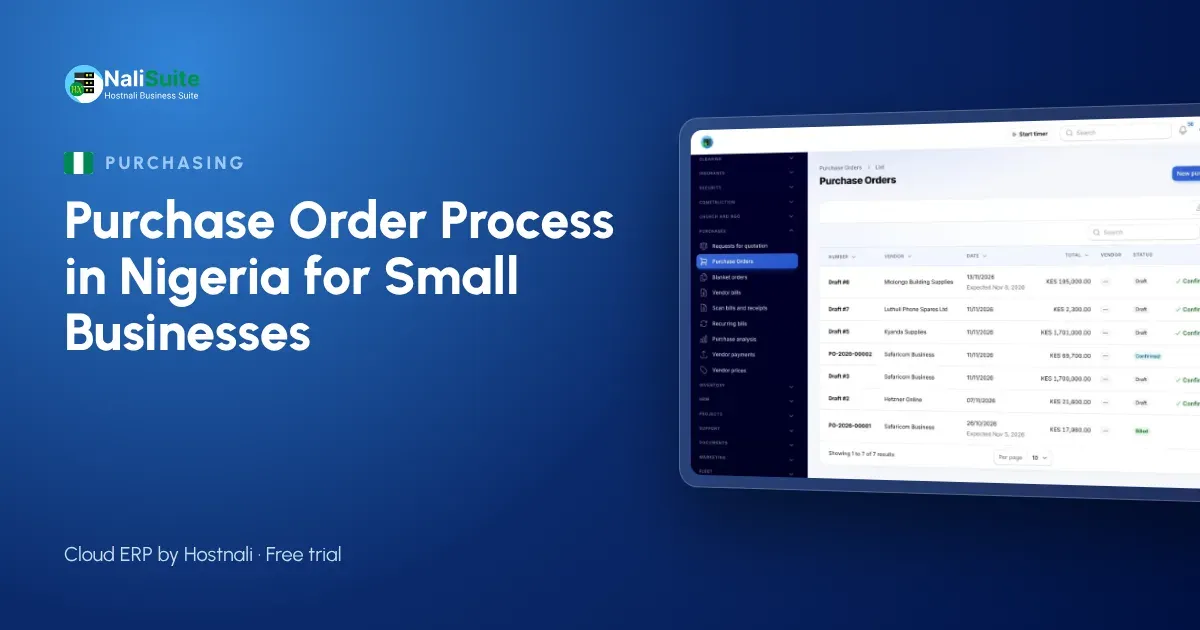
Software turns the process into a few taps. NaliSuite Purchases takes a request through approval to a PO, records what is received into inventory, and sends matched supplier bills to accounting, ready to pay.
Frequently asked questions
Do Nigerian suppliers have to charge VAT?
VAT-registered suppliers charge VAT at 7.5%. Check each supplier invoice and keep it with the bill for your VAT records.
How do I pay suppliers in Nigeria?
Most suppliers are paid by bank transfer. Pay only bills that have been matched to a PO and a goods received note, and record each payment against the bill.
What if a supplier delivers more than we ordered?
Accept only what is on the PO, or update the PO first if you want the extra. Otherwise the bill will not match.
Do I need purchase orders for services?
Yes, for regular services such as repairs or transport. The PO fixes the agreed price before the work starts.
Try NaliSuite
NaliSuite brings purchase orders, inventory and supplier bills into one cloud system. Plans start at ₦3,125 a month. See what is included.