 NGN
 KES - Kenya
 UGX - Uganda
 TZS - Tanzania
 RWF - Rwanda
 ZAR - South Africa
 USD - Zimbabwe
 GHS - Ghana
 ETB - Ethiopia
 ZMW - Zambia
 USD - International

Rental property in Nigeria comes with its own habits: rent often paid a year at a time, service charges for estates, caution deposits and agents managing buildings for owners who live elsewhere. Keeping on top of all of it in a notebook or a WhatsApp chat is how disputes start. These tips will help landlords and property managers keep clean records from the first viewing to the renewal.
A worked example: a small estate in Lekki
Consider a property manager looking after a small estate of terraces in Lekki for three owners. Some tenants pay rent yearly and service charge quarterly; diesel and security are shared costs. The manager used to calculate each tenant’s share by hand every quarter. Setting up each unit with its rent cycle and service charge, and recording shared costs once, means invoices go out on time and each owner gets a statement for their own units.
Rent and charges on a schedule
Recurring billing is the single biggest time saver for landlords. Rent, service charge and any fixed charges are invoiced on the same day every period, with utilities added from meter readings.
Tenants receive the invoice by email or WhatsApp with a link to pay by card or bank transfer.
See who owes what, and for how long
An arrears report shows each tenant’s unpaid balance and how old it is. Check it weekly, call anyone more than a few days late and agree a plan in writing if they are struggling.
The longer a debt is left, the harder it is to collect. Early, friendly contact recovers more than late, angry contact.
Set up every property and unit once
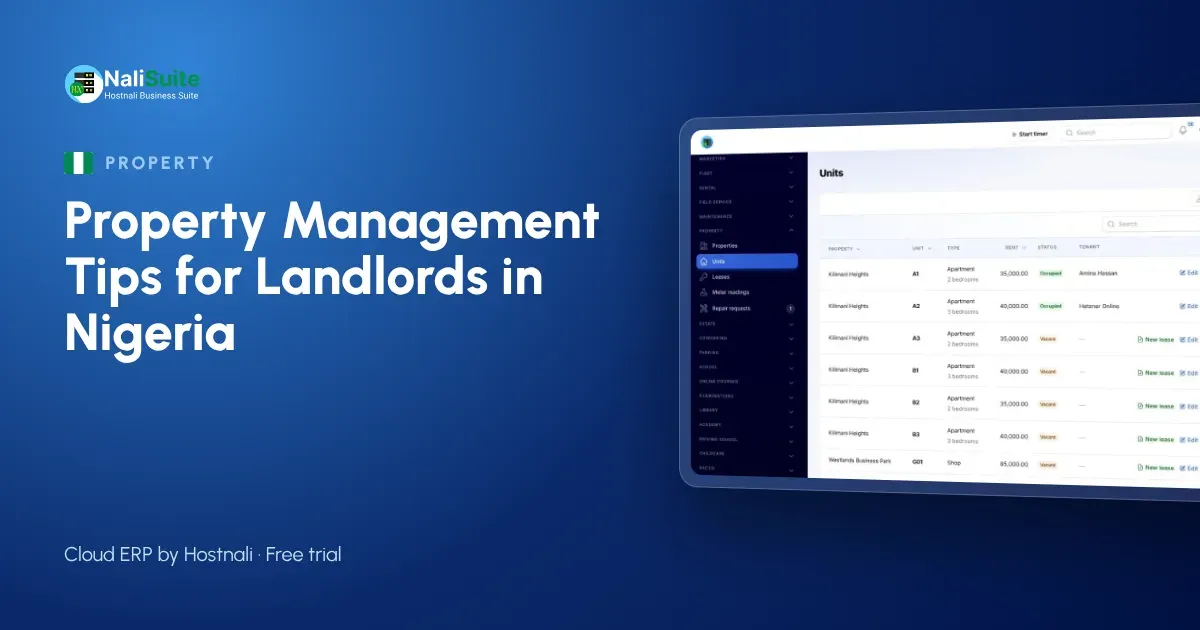
Start by listing each building and every unit in it: flat, room, shop or office. Record the size, the rent, any service charge and whether it is let or empty.
With that in place you can see occupancy at a glance, and every invoice, payment and repair has a home. Empty units stand out immediately instead of hiding in a spreadsheet.
Keep leases and deposits on record
Store each lease against its unit with the start and end dates, rent, payment day, any agreed yearly increase and the deposit received. Attach the signed lease and the tenant’s ID.
When renewal comes round, you have the terms in front of you. When a tenant moves out, the deposit is already recorded and ready to settle.
Yearly rent, renewals and bank transfers
Where rent is paid yearly, the renewal date matters more than any monthly routine. Set reminders well ahead of each renewal so you can agree terms, issue the invoice and collect payment before the date passes.
Most tenants pay by bank transfer, so ask them to use their unit or tenant reference. Matching bank credits to tenants is far easier when every payment carries a reference.
A simple move-in and move-out routine
Most deposit disputes start with a missing record of the unit’s condition. At move-in, walk through the unit with the tenant, note the condition room by room, take photos and have both sides sign. Record the meter readings on the same day.
At move-out, repeat the walk-through against that record. Anything that differs is easy to agree on, and the deposit can be settled the same week.
Doing it in NaliSuite
Everything above is what the Property Management add-on in NaliSuite does: units and occupancy, leases and deposits, automatic rent and service charge invoices, meter readings, arrears with late fees, tenant repair requests and landlord statements.
If you also hire out equipment, vehicles or a venue, the Rental add-on handles bookings, deposits and late returns. Payments come in through card and bank, and every invoice and receipt posts to Accounting. The property section shows the full set.
Repairs and the tenant portal
Tenants can report repairs, see their invoices and download statements from a portal, instead of calling you at night.
Every request is recorded against the unit with its status, so nothing gets lost between you, the caretaker and the contractor.
Know what each property really earns
Rent received is only half the story. With repairs, utilities and fees recorded against each property, you can see the net income per unit and per building.
That makes it easier to set rents, plan improvements and talk to your accountant at the end of the year.
Treat tenant records as confidential: follow the Nigeria Data Protection Act, 2023, overseen by the Nigeria Data Protection Commission, and keep signed leases and IDs in one secure place rather than on several phones.
Frequently asked questions
Can I bill rent yearly and service charge quarterly?
Yes. Each charge can have its own cycle, so yearly rent and quarterly service charge are invoiced on their own schedules for the same tenant.
Can I manage properties for several owners?
Yes. Each unit belongs to an owner, and each owner receives a statement for their own units only.
Can tenants see their own statements?
Yes. Tenants can log in to the customer portal to see invoices, payments and their balance, and to report repairs.
What does it cost?
NaliSuite plans start from ₦3,125 a month with a free trial; the Property Management add-on is added to any plan.
Try NaliSuite
Try it with your own properties: set up your units during a free trial and compare it with your current records for a month. Compare the plans.