 NGN
 KES - Kenya
 UGX - Uganda
 TZS - Tanzania
 RWF - Rwanda
 ZAR - South Africa
 USD - Zimbabwe
 GHS - Ghana
 ETB - Ethiopia
 ZMW - Zambia
 USD - International

In many Nigerian businesses, the month’s sales live in a stream of bank alerts. Transfers arrive with half a name, POS settlements land a day later and some customers still pay in cash. At month end, someone has to turn all of that into numbers that make sense.
The checklist below is organised by area rather than by date. Work through the five areas in order, tick each item, and you will have a month that is closed properly.
Area 1: Money received
This is where most of the work is, because customers pay in so many ways.
- Bank transfers. Download the statement for each business account. Link every credit to an invoice or sale. Transfers with unclear narrations go on a query list.
- POS and card settlements. Compare the settlement report from your payment provider with the sales recorded at the till. Note the charges deducted.
- Cash. Count the cash, compare it with recorded cash sales and bank what you can.
- Online payments. If customers pay invoices online through a provider such as Paystack, check that each payment is linked to its invoice.
NaliSuite Accounting imports bank statements and suggests which invoice each credit belongs to. The bank reconciliation feature explains the matching, and online payments covers the pay links on invoices.
Area 2: Money spent
- Collect every supplier invoice dated in the month, including those sent by WhatsApp.
- Check each one against what was ordered and delivered.
- Record diesel and generator costs, which are a large expense for many Nigerian businesses and are often paid in cash.
- Record bank charges, levies and transfer fees shown on the statement.
- Confirm rent, salaries and loan repayments have gone out.
A common gap is spending paid from a personal account “just this once”. Record it as money the business owes the owner, so the cost is not lost.
Area 3: Customers and stock
Debtors
Print the list of unpaid invoices by age and decide what to do with each:
| How late | What to do |
|---|---|
| A few days | Send a reminder with a payment link |
| About a month | Call the customer and send a statement |
| Two months or more | Agree a payment plan or stop supplying on credit |
NaliSuite Invoicing sends reminders and statements by email or WhatsApp, and each one carries a link to pay online.
Stock
Count your high-value lines and your fastest sellers. If the shelf count differs from the system, record the adjustment with a reason. Over time, the reasons tell you where stock is going: damage, expiry, theft or wrong receiving.
Area 4: Staff and payroll
- Confirm that the month’s payroll was approved and paid.
- Check that PAYE, pension and other deductions are recorded as amounts owed and paid on time.
- File payslips where staff can find them.
NaliSuite’s Nigerian payroll works out PAYE and the deductions on each payslip. To check one salary by hand, use the free PAYE calculator.
Area 5: Tax, reports and locking
VAT
If your business is registered for VAT, the standard rate is 7.5%. Add up VAT on sales, subtract VAT on purchases you can claim and check the result against your invoices. Confirm current filing dates with the Nigeria Revenue Service (NRS).
E-invoicing
Where your business has to send invoices through the NRS e-invoicing system, check that every invoice for the month was accepted. NaliSuite provides the connection; you register and get your own credentials. The e-invoicing page explains the set-up.
Reports
Read three reports before you lock:
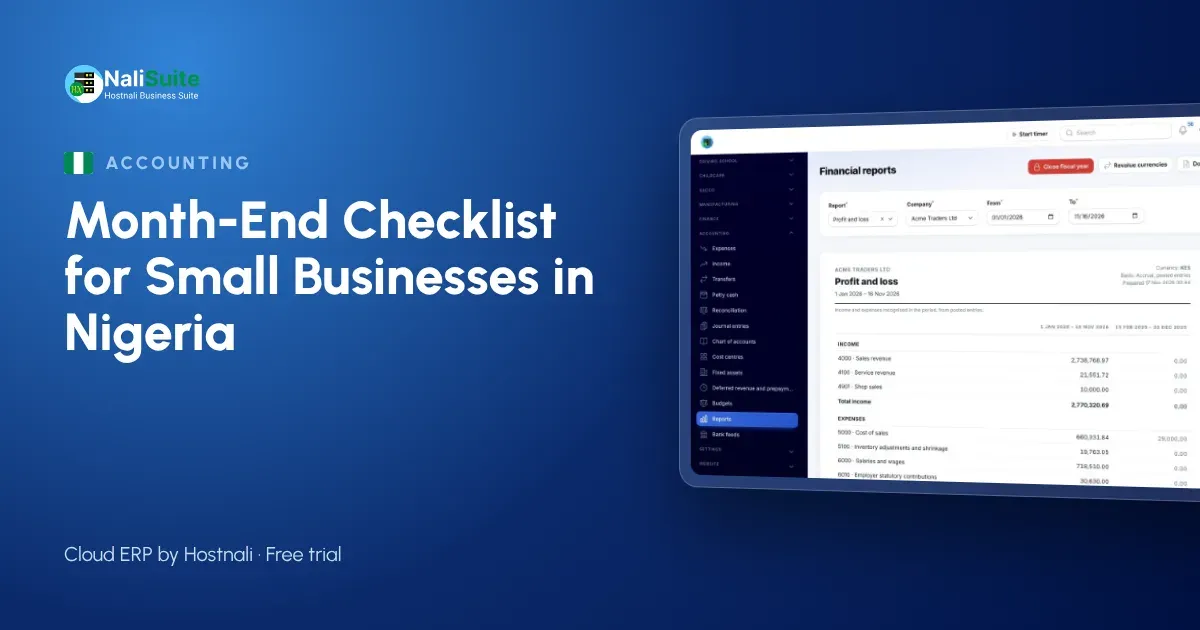
- Profit and loss, compared with last month.
- Balance sheet, with bank balances matching the statements.
- Aged receivables, showing what customers owe.
Then lock the month so no one changes it by accident.
A worked example from Lagos
Tunde runs a small printing business in Yaba with four staff. His customers pay mostly by transfer, and the narrations rarely match the invoice number. At his first proper close he found nine transfers he could not identify. He called his regular customers, matched seven and recorded the last two as unidentified receipts until the senders came forward. He also discovered that generator diesel, paid in cash from the till, had never been recorded, so his profit had been overstated for months.
Habits that make the next close easier
- Ask customers to put the invoice number in the transfer narration.
- Use one bank account for business only.
- Match bank alerts weekly, not once a month.
- Keep receipts for cash spending in one envelope per month.
Frequently asked questions
How do I match transfers that only show part of a customer’s name?
Look at the amount and date first, then the name. If you still cannot tell, call the likely customers. Asking for the invoice number in the narration prevents most of these cases.
Should I record POS charges separately?
Yes. Record the full sale as income and the charge as a cost. That way, your sales figure is correct and you can see what payment charges cost you.
What if my accountant only visits once a quarter?
Do the monthly close yourself or with a bookkeeper, and let the accountant review three closed months at once. It is far quicker than starting from raw statements.
Can I do this on my phone?
Most of it, yes. NaliSuite runs in a browser on a phone or laptop.
Try NaliSuite
NaliSuite puts invoices, bank matching, payroll and e-invoicing for Nigerian businesses in one cloud system. Plans start at ₦3,125 a month with a free trial; compare the plans or read more about NaliSuite.