 NGN
 KES - Kenya
 UGX - Uganda
 TZS - Tanzania
 RWF - Rwanda
 ZAR - South Africa
 USD - Zimbabwe
 GHS - Ghana
 ETB - Ethiopia
 ZMW - Zambia
 USD - International

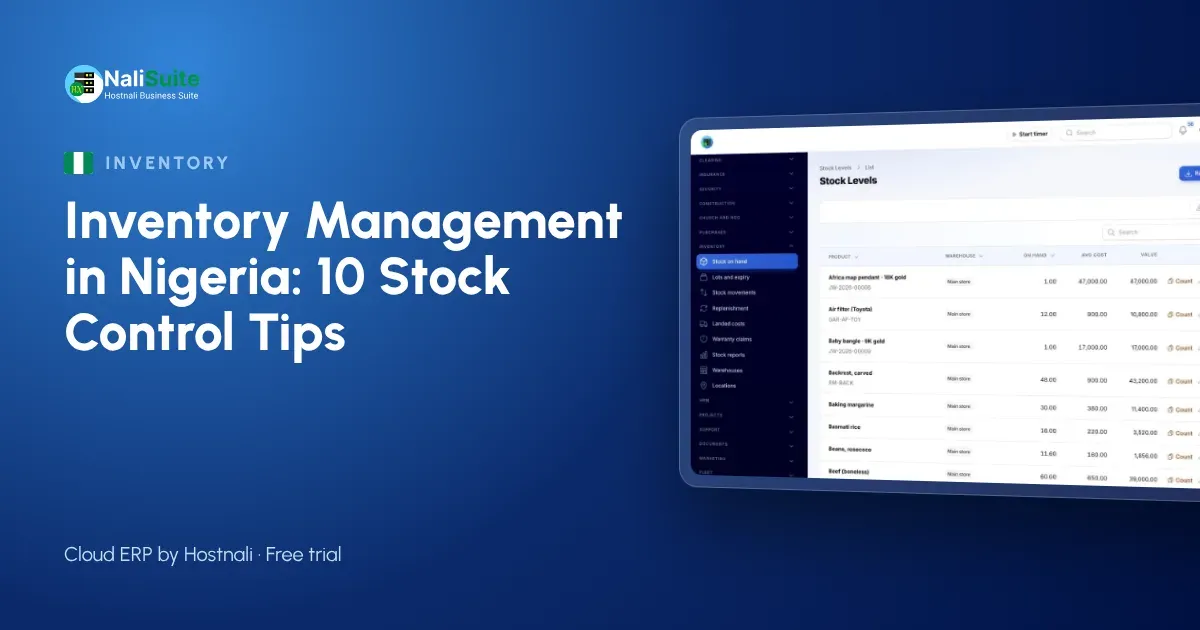
For a Nigerian business, stock is cash you cannot spend. Prices shift with the naira, suppliers change terms, and a single bad buying decision can lock up working capital for months. Good inventory management will not fix the economy, but it will tell you exactly where your money is sitting. Here are ten practical tips.
Set reorder points for your best sellers
A reorder point is the stock level at which you place a new order. Work it out from how much you sell each day and how long your supplier takes to deliver, then add a small safety buffer. For example, if you sell 10 cartons a day and delivery takes 5 days, reorder when you have about 60 left.
Start with your top 50 items. Once those never run out, extend reorder points to the rest of the range.
Why stock control is harder in Nigeria
Inflation tempts businesses to buy early before prices rise again. That can be smart, but only if you know what will actually sell. Distributors often run several warehouses or depots across Lagos, Kano or Onitsha, and stock moves between them by road, which creates room for errors and theft.
Pharmacies and food businesses also deal with regulated products, where batch numbers and expiry dates must be traceable. A notebook cannot do that reliably at scale.
Several shops or warehouses
Once you have a second shop or a warehouse, give each its own stock location. Sales at each till reduce that location’s stock, deliveries go into the right one, and transfers move goods between them with a record of who sent what and when.
The payoff is simple: before you buy more, you can check whether another branch already has it.
Example: a beverage distributor in Kano
A beverage distributor in Kano supplies shops across the city from two depots. Trucks load in the morning and return in the evening with empties and unsold cases. By recording every transfer from depot to truck and every return, the owner sees exactly what each driver delivered and what came back. Shortfalls show up the same day, not at month-end.
Reorder levels per depot mean the next order to the bottler is based on real movement, not a guess before prices go up.
Know what is not selling
Stock that does not sell is cash you cannot use. Run a report of items with no sales in the last 60 or 90 days and decide what to do with each: discount, bundle with a fast seller, return to the supplier or stop reordering.
Do the same with overstock: lines where you hold months of sales. Ordering less, more often, keeps cash available for what actually sells.
Mistakes to avoid in Nigeria
- Panic buying before a price rise. Buying ahead can protect margins, but only for lines you know will sell. Check the sales history first.
- No record of what leaves on the truck. Every load should be a transfer or a delivery note; otherwise shortages are invisible.
- Cost prices that never change. If you do not update cost prices with each delivery, your margin reports are fiction.
- Trusting the annual count alone. Small weekly counts in each depot catch problems months earlier.
Count your stock properly, once
Everything else depends on knowing what you have today. Pick a quiet day, count every item once, and enter the figures as your opening stock. Use barcodes where you can: a phone camera or a cheap USB scanner is faster and more accurate than writing on paper.
After that first full count, switch to cycle counting: count a different section each week, starting with fast movers and high-value items. Small, regular counts catch errors early and never close the shop.
Getting started in Nigeria
Start by listing every product with its cost price, selling price and barcode, and import the list from a spreadsheet. Count your stock once to set opening levels in each warehouse or shop.
Record your supplier for each line and the usual lead time, then set reorder levels. When prices rise, update cost prices on each delivery so your margin reports stay accurate. For deliveries by truck between depots, record a transfer each time, and check returns against what was sent.
Finally, connect sales: every sale at the till should reduce stock automatically, and every transfer payment should be matched to its sale.
Frequently asked questions
Can I see stock in each warehouse and on trucks?
Yes. Each warehouse, shop or vehicle can be its own stock location, and transfers between them show exactly where stock is.
Do I need barcodes?
They are not essential but they make counting and selling faster and more accurate. NaliSuite prints barcode labels and scans with a USB scanner or a phone camera.
What is cycle counting?
Counting a small part of your stock each week instead of everything at once, so errors are caught early and the shop never closes for a stock-take.
Try NaliSuite
Every NaliSuite plan, from ₦3,125 a month, includes inventory, purchases and an offline till, so stock and sales are always in one place. Try it free.