 NGN
 KES - Kenya
 UGX - Uganda
 TZS - Tanzania
 RWF - Rwanda
 ZAR - South Africa
 USD - Zimbabwe
 GHS - Ghana
 ETB - Ethiopia
 ZMW - Zambia
 USD - International

Ask a Nigerian business owner where the money went last month and you may get a shrug. Sales were good, the shop was busy, yet the account is low. Usually the problem is not one big expense. It is a dozen small leaks that nobody is tracking: diesel bought in jerrycans, transport “for the boys”, subscriptions nobody uses, bank charges and petty cash that never balances.
This guide starts with those leaks, then shows how to set up expense tracking that closes them.
Leak 1: Diesel and power
For many businesses, generator diesel is one of the biggest monthly costs, and one of the least controlled. It is bought in small amounts, often in cash, by different people.
Close it: buy from as few suppliers as possible, keep a fuel log next to the generator (date, litres added, running hours), and compare litres bought with litres used each week. A sudden jump in consumption with no change in running hours needs an explanation.
Leak 2: Petty cash
Petty cash is useful and dangerous. Without vouchers, a float of any size disappears into “transport”, “logistics” and “sundries”.
Close it: keep a fixed float, pay out only against a signed voucher stating purpose and amount, attach a receipt whenever there is one, and top up only for the vouchers presented. Count the float at every top-up, and make one person responsible for it.
Leak 3: Logistics and transport
Dispatch riders, okada and keke fares, haulage and fuel for delivery vehicles are hard to verify after the fact.
Close it: record each delivery with its destination and cost. For regular routes, agree a fixed rate with riders or logistics companies. Compare transport cost per delivery month by month.
Leak 4: Subscriptions and software
Software, cloud storage, design tools, streaming for the waiting area, data bundles on several lines: many are billed to a card monthly and forgotten.
Close it: list every subscription with its cost and owner. Cancel anything nobody can justify. Review the list every quarter.
Leak 5: Bank charges and payment fees
Transfer fees, card machine charges, SMS alerts, stamp duty and maintenance fees are small per transaction but large over a year.
Close it: give bank charges their own category so you can see the total, and compare it across your accounts and payment providers.
Leak 6: Unapproved purchases
When anyone can buy anything, duplicates and overspending follow.
Close it: require a purchase order for stock and supplier orders, and set approval limits for other spending. In NaliSuite purchases, purchase orders, bills and expenses over an amount you choose need approval before they go ahead, and supplier bills are matched against what was ordered and received.
Building records that hold up
Closing leaks depends on good records. For each expense, keep:
- the date and amount,
- the supplier or person paid,
- what it was for, in plain words,
- who approved it,
- a receipt or invoice, or a signed voucher where there is none.
If your business is registered for VAT, keep proper invoices from suppliers so input VAT can be supported, and keep records for as long as the Nigeria Revenue Service requires. Check the current rules with NRS or your tax adviser.
Capture quickly
Staff should photograph receipts on the day. With NaliSuite’s employee self-service, they submit expense claims from their phones with the photo attached, and managers approve from theirs. For supplier invoices, the Document AI add-on reads PDFs and photos and prepares a draft bill or expense for you to check; it runs on your business’s own Anthropic API key.
Categorise the same way every time
Use one list of categories – stock, diesel and power, transport and logistics, staff, rent, marketing, software and subscriptions, bank charges, professional fees, repairs – so you can compare one month with the next.
Reconcile every month
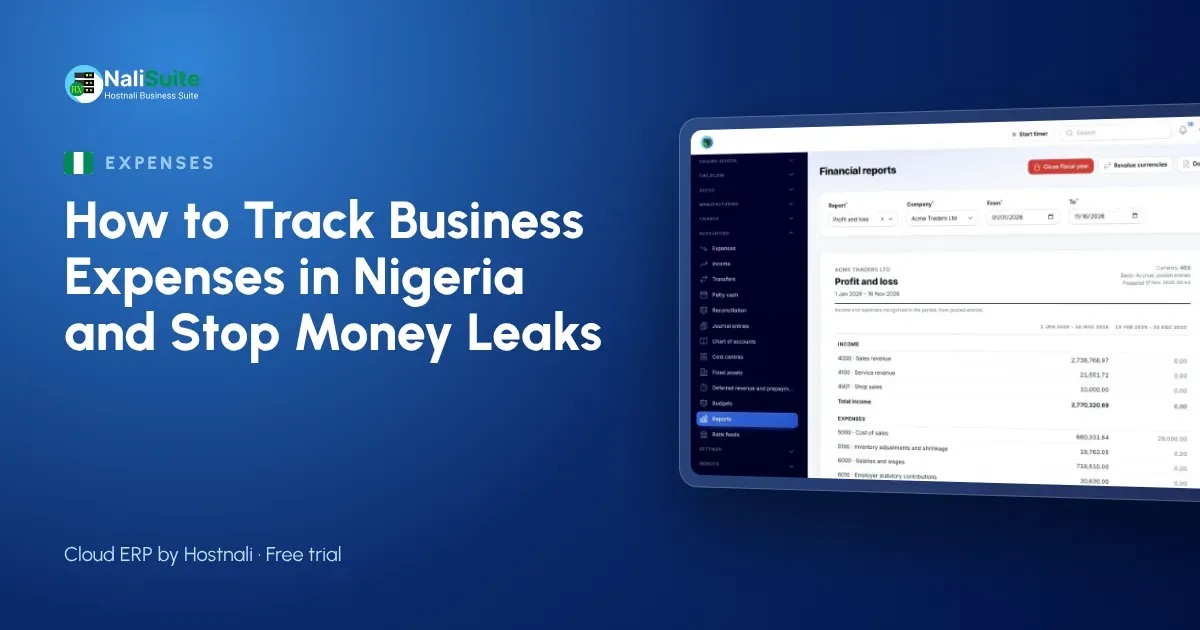
Reconciliation is where leaks become visible. Match every debit on your bank statements to a recorded expense, and every recorded expense to a payment. Anything left over is either a missing receipt or a problem.
NaliSuite accounting imports statements or connects bank feeds and suggests matches, and bank reconciliation shows the unmatched items so you can deal with them quickly.
A real-world style example
A sample logistics company in Ibadan tracked diesel properly for the first time and found its two generators used very different amounts for the same running hours. One needed servicing; the other was being drained. Fixing both cut the diesel bill noticeably within two months. The company had been paying for the problem for over a year without seeing it.
Review the summary weekly
A short weekly look at spending by category shows leaks while they are still small.
Frequently asked questions
What is the first leak I should look at?
Whatever your biggest cost after stock and salaries is. For many Nigerian businesses that is diesel and power.
How do I handle expenses with no receipt?
Use a signed voucher with the date, amount, purpose and the name and phone number of the person paid.
How often should I review expenses?
Glance at them weekly and reconcile monthly. Leaks are easier to stop early.
Try NaliSuite
NaliSuite brings expense claims, purchase approvals, supplier bills and bank reconciliation into one system. Plans start at ₦3,125 a month, shown in naira, with a free trial. See the plans.