 NGN
 KES - Kenya
 UGX - Uganda
 TZS - Tanzania
 RWF - Rwanda
 ZAR - South Africa
 USD - Zimbabwe
 GHS - Ghana
 ETB - Ethiopia
 ZMW - Zambia
 USD - International

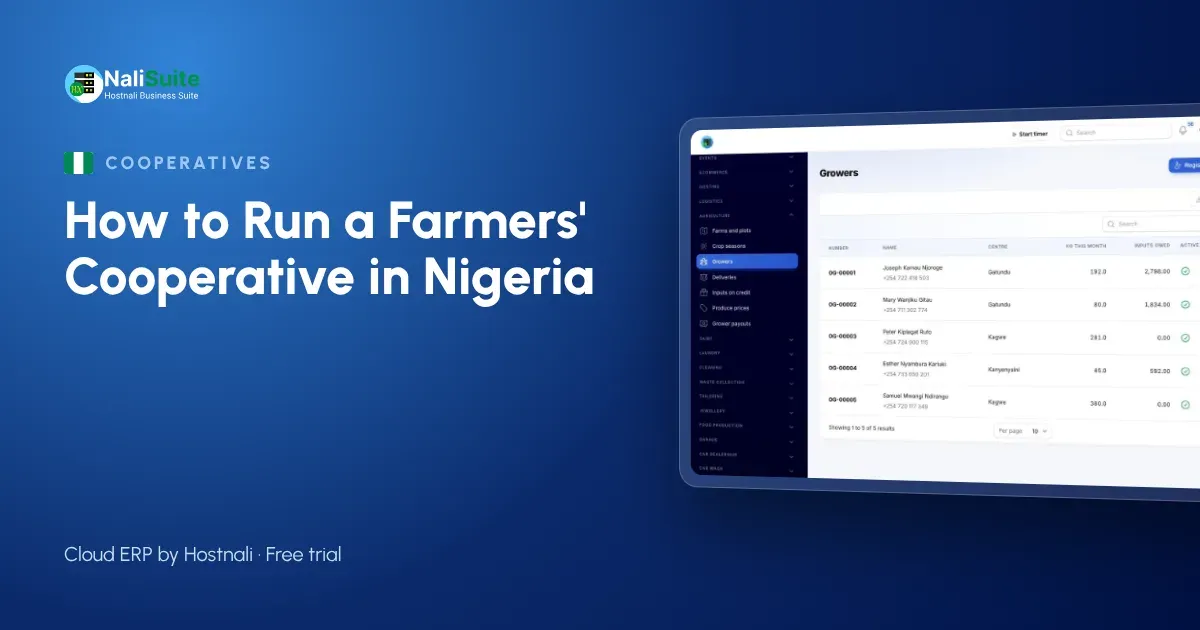
Farmers’ cooperatives in Nigeria give smallholders what they cannot get alone: better prices, shared inputs and access to buyers who want volume. They also carry a heavy administrative load. Every bag of rice, maize or cassava has to be weighed, every input given on credit has to be recovered, and every member has to be paid correctly by bank transfer. This guide shows how to keep that work organised.
Start with a clean member register
Everything else depends on the register. Give every member a number, and record their name, phone, payment details, the route or collection centre they use and the date they joined. Add next of kin, because a member’s family will need to be paid if the member dies or falls ill.
Review the register once a season. Mark members who have stopped delivering as inactive rather than deleting them, so their history and any balance they still owe stay on record.
Weigh, grade and confirm each delivery
Members judge the cooperative at the scale. Weigh every delivery in front of the member, record the grade or quality check, and confirm the entry with a text message to the member’s phone before they leave.
The same record drives the payout, the stock received into the store and the figures you report to your buyer, so a delivery is only ever entered once.
Track what members owe before payday
Credit is where cooperatives lose money quietly. Every bag of fertiliser, sack of feed or cash advance given to a member should be recorded against them as it leaves the store, not reconstructed from memory at the end of the season.
Set a limit on credit per member, linked to what they usually deliver, so nobody falls so far behind that their payout disappears entirely.
Levies, shares and savings
Most cooperatives take something from each payout for the group itself: a levy, share contributions or savings. Set the rates in the system once, so they are applied the same way to every member.
Where members also save or borrow through the cooperative, keep those balances in the same place as their deliveries, so one statement tells the full story.
A worked example: a rice outgrower scheme in Kebbi
Imagine a rice cooperative in Kebbi State that supplies a mill under an outgrower arrangement. Before planting, the cooperative gives members seed, fertiliser and herbicide on credit. At harvest, paddy is weighed at the cooperative store, graded and priced. In the past, the secretary kept three separate notebooks for inputs, deliveries and payments, and reconciling them took weeks after harvest. Recording inputs against each member at issue, and deliveries at the scale, means the settlement sheet for every farmer is ready the day the mill pays the cooperative.
Pay members on time, every time
Fix a payout date and keep to it. On that date, the system works out each member’s earnings, takes off the agreed deductions and produces the payout list. Pay members by bank transfer, and record each payment against the member so the statement shows it.
Paying late, even by a week, pushes members to side-sell to traders who pay cash at the gate.
Paying members by bank transfer
In Nigeria most cooperatives settle members by bank transfer. Collect each member’s account name and number when they join, and check that the name matches the member register, because a mismatch is the most common reason a transfer bounces or goes to the wrong person.
Many members now use their phones for banking, so a text or WhatsApp message with the amount and a short breakdown on payout day goes a long way. Keep a copy of every settlement sheet the members sign or acknowledge, and file it with the bank statement for the same period.
Show members their numbers
Trust grows when members can check the figures themselves. A short statement with deliveries, price, deductions and payout, sent after every payday, answers most questions before they are asked.
Keep reports for the committee too: deliveries by route or centre, credit outstanding, and payouts per period. They show where problems are building before members notice.
Putting it into practice with NaliSuite
The routine above maps directly onto NaliSuite. Deliveries, store credit and payouts for dairy groups run in the Dairy Cooperative Milk Collection add-on; crop collections, input credit and grower payouts in the Agriculture and Outgrowers add-on; savings and loans in the SACCO and Microfinance add-on.
All three share the same member records and post to the same Accounting books, and payouts go out through your bank or payment provider. The farms and cooperatives overview lists every app a cooperative typically uses.
A note on member data: the register holds names, phone numbers and payment details, so treat it carefully. In Nigeria that means following the Nigeria Data Protection Act, 2023, overseen by the Nigeria Data Protection Commission. Limit who can see member records and never share lists outside the cooperative.
Frequently asked questions
How do we pay members who have no bank account?
Encourage members to open an account when they join, ideally with a bank that has agents in your area. Until then, record any cash payout with a signed receipt so the books still balance.
Can the cooperative track input loans per member?
Yes. Inputs issued on credit are recorded against each member and recovered automatically from their harvest payout, so the settlement shows what was owed and what was deducted.
Can members get a receipt for every delivery?
Yes. Each delivery recorded at the collection point sends a text receipt to the member’s phone with the quantity and date.
What does it cost to start?
NaliSuite plans start from ₦3,125 a month, with a free trial, and the cooperative add-ons are added to any plan.
Try NaliSuite
The best way to judge it is to try it with your own members. A free trial lets you set up the register, record deliveries and run a test payout before committing. Compare the plans.