 NGN
 KES - Kenya
 UGX - Uganda
 TZS - Tanzania
 RWF - Rwanda
 ZAR - South Africa
 USD - Zimbabwe
 GHS - Ghana
 ETB - Ethiopia
 ZMW - Zambia
 USD - International

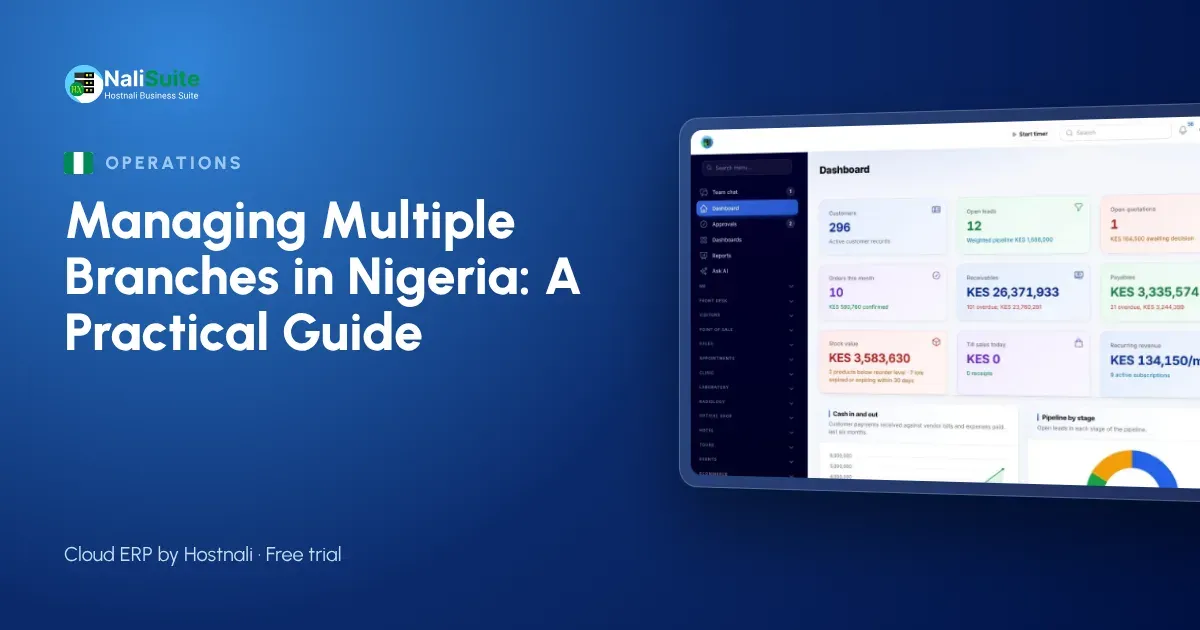
Many Nigerian businesses grow by opening outlets: a second pharmacy across town, a supermarket in a new estate, a branch in Abuja after the Lagos shop has proved itself. The products are the same, but the control problems multiply, from stock that “disappears” between outlets to cash that never quite matches the till.
A familiar story
Think of a pharmacy group with outlets in Ikeja, Surulere and Wuse in Abuja. Drugs with short expiry dates are moved between outlets so they sell in time, cash and POS terminal takings are counted at night, and the owner gets a WhatsApp photo of each day’s sales book. When an expensive antibiotic runs out at Wuse, nobody knows whether Ikeja still has a carton.
None of this is unusual. It is what happens when a business built around one owner in one place starts to run in several. The answer is not more WhatsApp groups. It is a system where every branch records the same things in the same way.
The building blocks of multi-branch control
- One product list for every branch. A product is created once and sold everywhere, with the same price list unless you choose otherwise.
- Stock per location. Inventory tracks each shop and warehouse separately, with lots and serial numbers where you need them.
- Transfers with a sender and a receiver. Stock leaving Abuja is added to Port Harcourt’s stock only when Port Harcourt confirms what arrived.
- A till per branch. The point of sale runs on a phone, tablet or laptop and keeps selling offline.
- Cost centres per branch. So the profit report reflects each branch’s own costs.
- One login per person. So every action has a name on it.
A till for every branch
Give every branch its own point of sale with a float, and open and close a session every day. At closing, the cashier counts and the system shows what should be there in cash and card. The till keeps working offline when the internet drops and syncs later.
Staff and logins
Give every staff member their own login instead of sharing one. Each sale, transfer and stock count then shows who made it. Users are counted per plan, so check that your plan covers everyone across your branches.
Reports per branch
Use a cost centre for each branch, so rent, wages and transport land against the right shop. The profit and loss report can then be run for Lagos alone, for Ibadan alone or for the whole business. More on the multi-company and branches page.
How to know a new branch is working
Give each new branch, for example the one in Ibadan, three months and watch a few numbers rather than gut feeling:
- Sales per week, compared with the branch’s first month.
- Gross margin, to check discounts and price changes are not eating profit.
- Stock days, how long current stock would last at the current sales rate.
- Cash differences at each till session.
- Profit after branch costs, from the cost centre report.
Keeping branch staff on the same page
Branch teams in Abuja and Port Harcourt work far from head office, so make the routine easy to follow: the same till opening and closing steps everywhere, transfers received the day they arrive and a short checklist for weekly counts. When everyone works in one system, head office can see problems early and help, rather than discovering them at the end of the quarter.
It also helps to visit with the numbers in hand. A trip to Kano is more useful when you already know which products are slow there, which cashier has had differences and which transfers took longest to arrive from Lagos. The visit becomes about fixing two or three specific things, not about counting boxes.
Branches in Nigeria: local points
Nigerian branches often take a mix of cash, POS terminal card payments and bank transfers, and each needs its own trail. Posting each outlet’s takings to separate accounts, and recording transfers against invoices instead of on paper, is what lets you see where a shortfall happened. Branches that are separate companies, for example with their own TIN, can each be set up as a company with its own books.
In Nigeria, power and connectivity vary between outlets, so a till that works offline and syncs later protects sales in a branch where the network drops in the afternoon. Diesel and generator costs belong in each outlet’s cost centre too; in some locations they decide whether the branch makes money at all.
Frequently asked questions
Can each outlet have its own bank account in the books?
Yes. You can post each till’s card, cash and transfer takings to the bank or cash account you choose, so every outlet’s money is tracked separately.
Can I track expiry dates across outlets?
Inventory tracks lots per location, and the Clinic and Pharmacy add-on adds batch expiry dates, so you can see which outlet holds stock that expires soon and move it in time.
How many branches can NaliSuite handle?
Every plan can run several branches; plans differ by users and storage. The Business and Enterprise plans suit larger teams, and Enterprise is made for groups and multi-company operations.
Try NaliSuite
NaliSuite runs inventory, point of sale, purchases and accounting for every branch in one cloud ERP, from ₦3,125 a month. Compare plans on the plans page and start a free trial.