 NGN
 KES - Kenya
 UGX - Uganda
 TZS - Tanzania
 RWF - Rwanda
 ZAR - South Africa
 USD - Zimbabwe
 GHS - Ghana
 ETB - Ethiopia
 ZMW - Zambia
 USD - International

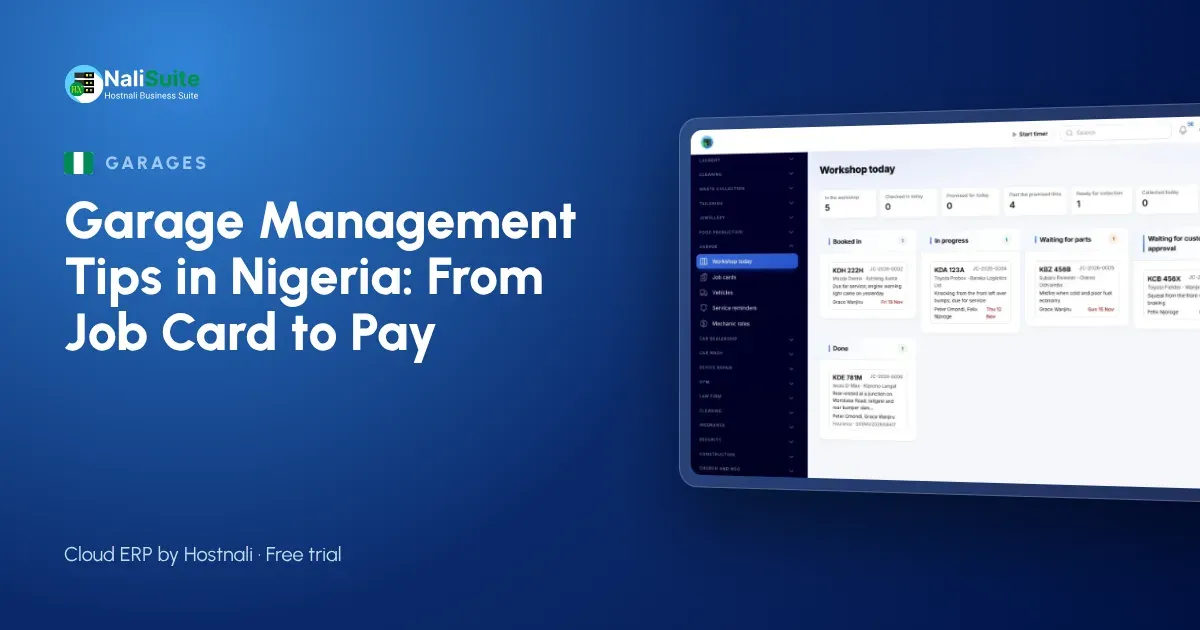
A Nigerian mechanic workshop can be the busiest place on the street. Cars arrive with long stories, parts come from several suppliers and the owner is often juggling customers, apprentices and suppliers at once. The workshops that grow are the ones that move from a notebook and a good memory to clear records.
Here is a practical way to run the work from the gate to payment.
An example workshop in Ibadan
Take a mid-sized workshop in Ibadan with three senior mechanics and several apprentices. A Corolla arrives with an overheating complaint. At the gate the service adviser opens a job card, notes the mileage and fuel and walks round the car with the owner. The fault turns out to be a water pump and a thermostat; the estimate goes to the owner by text and is approved within the hour. Parts are issued from the store against the job, the mechanic logs his hours, and the invoice is ready when the owner returns.
Estimates, approvals and no surprises at the counter
Write the estimate in three parts: parts with their prices, labour, and outside work you will send to another workshop. Send it to the customer and ask them to approve it in writing. If the mechanic finds a worn bearing halfway through the job, stop and send a revised estimate rather than adding it to the bill at the end.
With NaliSuite’s garage and auto workshop add-on, estimates of parts, labour and outside work are sent by email and text and approved before work starts, so approvals no longer live in someone’s phone.
Check-in: the five minutes that save an hour later
A proper check-in takes five minutes. Note the mileage, how much fuel is in the tank, what the customer says is wrong and anything already damaged on the body or the interior. Ask the customer to confirm it. When the car is collected and someone asks about a new scratch or an empty tank, you have the answer on paper instead of a disagreement at the counter.
Keep that record on a job card that follows the car through the workshop. With NaliSuite the card records the odometer, fuel level, complaint and checklist, and the vehicle is filed under its plate for next time.
Remember every car, remind every customer
Repeat business comes from two habits: keeping a clear history for each vehicle and reminding the owner before the next service. Both are easy to drop when the workshop is busy, which is why they belong in the system, not in a notebook.
In NaliSuite vehicles are kept by plate with their full service history, and customers get a text when the next service is due.
Nigeria: payments and customer data
Nigerian customers increasingly pay by card or bank transfer, and corporate clients will want invoices that show your TIN. NaliSuite invoices carry a pay link through your own payment provider, such as Paystack. Where e-invoicing applies to your business, NaliSuite provides the connection to the NRS (formerly FIRS) system and you use your own credentials. Customer phone numbers and plates are personal data under the Nigeria Data Protection Act, 2023, so keep them secure.
Keep a tight grip on spare parts
Decide who can take parts from the store and make every issue go against a job. Count the fast movers, such as oil filters, brake pads and bulbs, every week. Set a reorder level for each so you are not sending a mechanic across town for a part you should have had on the shelf.
NaliSuite issues parts from stock against the job card, and the Inventory app keeps stock levels, reorder rules and supplier prices in one place.
Insurance work: two invoices, one job
Insurance repairs pay well but tie up cash. Keep them moving by invoicing the insurer and the customer’s excess separately the day the car is ready, each with the approved estimate attached.
NaliSuite’s garage add-on can split an invoice between the insurer and the customer’s excess.
Mistakes that cost workshops money
- Starting work on a verbal estimate.
- Parts leaving the store without a job card.
- Invoices written from memory at the end of the day.
- No record of what was done to a car last time.
- Customers left to remember their next service.
Clear records close these gaps.
Getting paid: the last step of every job
When the car is ready, the invoice should be ready too. Build it from the job card, with the approved parts, labour and outside work, and offer the customer quick ways to pay: card or bank transfer. Record each payment against the invoice so you always know who still owes you.
NaliSuite raises invoices on completion from the job card through Invoicing, and payments land against the right invoice.
Add a car wash or fleet customers when you are ready
Many garages grow by adding a car wash bay or by servicing company fleets. A car wash needs a queue by plate, packages by vehicle type and washer commission. Fleet clients want service history and reminders for every vehicle they own.
NaliSuite covers both with the car wash add-on and the Fleet add-on. The motor trade section shows how they fit together.
Frequently asked questions
Can I see which mechanic used which parts?
Yes. Parts are issued from stock against the job card and labour is logged per mechanic, so each job shows who worked on it and what was used.
Is it affordable for a small workshop?
Yes. Plans start from ₦3,125 a month, and the garage and auto workshop add-on can be added to any plan.
Do customers need to come in to approve an estimate?
No. Estimates are sent by email and text and approved before work starts.
Do I need to install software?
No. NaliSuite runs in the browser on a computer, tablet or phone, so job cards can be opened in the yard.
Try NaliSuite
Start a free trial of NaliSuite, add the garage add-on and open your first job card today. Plans start from ₦3,125 a month; compare the plans.