 NGN
 KES - Kenya
 UGX - Uganda
 TZS - Tanzania
 RWF - Rwanda
 ZAR - South Africa
 USD - Zimbabwe
 GHS - Ghana
 ETB - Ethiopia
 ZMW - Zambia
 USD - International

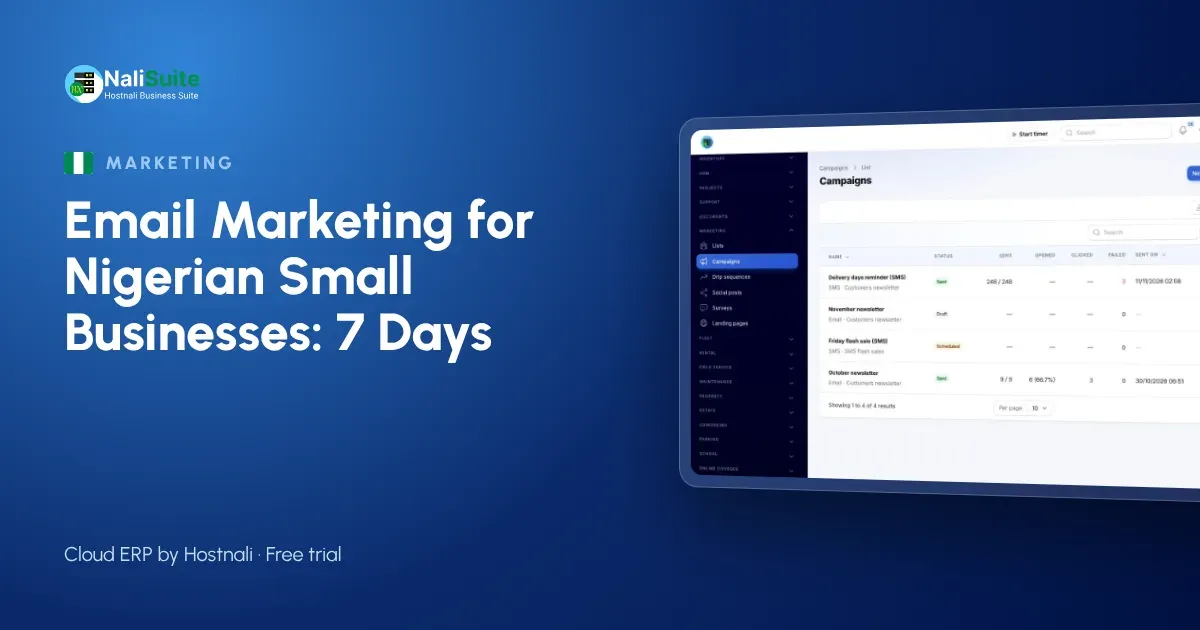
Many Nigerian small business owners know they should be doing email marketing, and many have put it off for months. The task feels big: a list to build, a design to make, words to write, rules to follow. It is easier than it looks if you break it into days.
This guide is a seven-day plan. By the end of the week you will have a consented list, a welcome sequence and your first campaign sent, all from a business email address customers trust.
Day 1: decide what the emails are for
Before you write a word, decide what a successful email would make people do. Pick one goal for the first month:
- More repeat orders from existing customers (good for shops, distributors, restaurants);
- More enquiries for a service (good for agencies, consultants, clinics, training centres);
- More visits to an event, a new branch or a sale.
Write the goal down. Every email you send this month should serve it.
Day 2: gather the people who already said yes
Look at where you already have customer details: invoices, order forms, your till, a spreadsheet, a WhatsApp business catalogue. Bring them into one place. In NaliSuite, the contacts app imports customers from Excel or CSV and finds duplicates for you.
Then separate the contacts who agreed to receive marketing from those who only bought something. Only the first group goes on your marketing list. For the others, a polite one-off message asking whether they would like updates is the right approach.
Day 3: set up your sign-up points
You want the list to grow without effort. Add:
- a subscribe form on your website, which in the NaliSuite marketing app feeds a list directly;
- a short landing page with one reason to join, for example early access to new stock or a monthly tip for your industry;
- a QR code at your shop in Lekki or your stand at a trade fair, linking to the form;
- a line on your invoices and receipts.
Day 4: write a welcome sequence
A welcome sequence is a set of emails that goes out automatically when someone joins. Three emails are enough to start:
- Welcome (sent immediately). Thank them, say how often you will write and what they will get.
- Your best offer or service (day 3). Explain it plainly, with a price or “from” price and how to buy.
- Answers to common questions (day 7). Delivery areas, payment by card or bank transfer, returns, opening hours.
In NaliSuite these are drip sequences that start when someone joins a list.
Day 5: write your first campaign
Keep it simple. One topic, one call to action, one button. A structure that works for almost any business:
- Subject line: a few words that say what is inside (“New Ankara prints in store this week”).
- Opening line: why this matters to the reader.
- The detail: two or three short paragraphs, or a few products with prices.
- The button: “Order now”, “Book a call”, “Get directions”.
- Sign-off: a real person’s name and your business phone number.
Most readers will open it on a phone, so keep paragraphs short and images light.
Day 6: check you will land in the inbox
Send campaigns from an address on your own domain, not from a free webmail address. Emails from a domain with proper authentication records (SPF, DKIM and DMARC) are far more likely to reach the inbox. Hostnali’s email hosting gives your business addresses on its domain, and our support team can help with the records.
Send a test to yourself and two colleagues using different email providers. Check it on a phone. Click every link.
Day 7: send, then learn
Schedule the campaign for a time your customers are likely to read it, for example a weekday morning for business customers or an evening for consumers. After a day or two, look at opens, clicks and replies. When campaigns and sales are in the same system, such as the marketing, CRM and sales apps in NaliSuite, you can also see which orders followed.
Note what you learned and plan next month’s email around it.
Staying within the Nigeria Data Protection Act
The Nigeria Data Protection Act 2023, enforced by the Nigeria Data Protection Commission (NDPC), applies to the names and emails on your list. Good practice:
- get clear consent before adding someone to a marketing list, and keep a record of it;
- explain what you will send and how often;
- include an unsubscribe link in every email (NaliSuite does this automatically and skips opted-out contacts);
- never buy or borrow lists.
Check the NDPC’s current guidance for any further requirements for your business.
After the first week
Once the basics run, add one improvement each month:
- Segments. Send different emails to retail and trade customers, or to Abuja and Lagos customers, using tags and purchase history.
- SMS and WhatsApp. Short reminders by SMS (through a supported SMS provider) or approved WhatsApp templates to opted-in customers. See WhatsApp in NaliSuite.
- Surveys. A short NPS survey tells you who loves you and who is about to leave.
Frequently asked questions
How big does my list need to be?
There is no minimum. A list of fifty engaged customers can produce more sales than five thousand strangers.
What if people unsubscribe?
That is normal and healthy. People who leave were unlikely to buy, and a smaller engaged list performs better.
Can I send SMS campaigns too?
Yes. Connect a supported SMS provider and send SMS campaigns to your lists from the same app.
Is the marketing app an extra cost?
No. It is one of the 17 built-in apps on every NaliSuite plan.
Try NaliSuite
Run your first week of email marketing with your own customer list. See the NaliSuite plans, from ₦3,125 a month, and start a free trial.