 NGN
 KES - Kenya
 UGX - Uganda
 TZS - Tanzania
 RWF - Rwanda
 ZAR - South Africa
 USD - Zimbabwe
 GHS - Ghana
 ETB - Ethiopia
 ZMW - Zambia
 USD - International

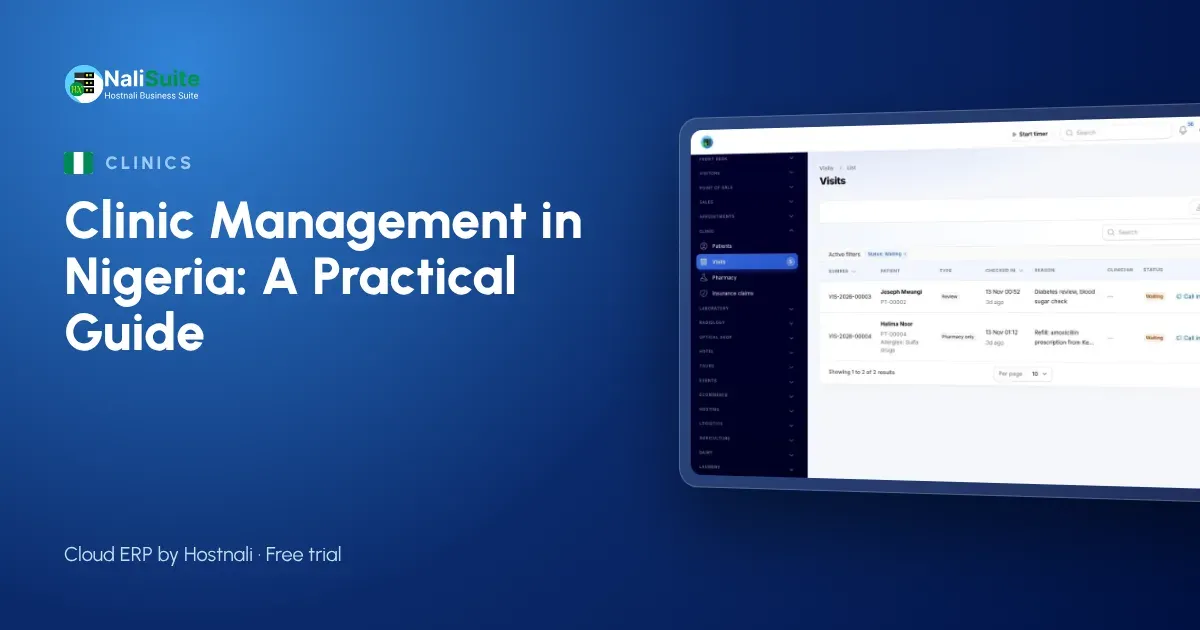
Private clinics and pharmacies in Nigeria carry a lot on a few shoulders: patients paying cash, enrollees on HMO or NHIA schemes, stock bought at changing prices and power that comes and goes. The practices that cope best have simple, consistent systems.
Here is how to organise yours, step by step.
Example: a family clinic in Ibadan
A family clinic in Ibadan sees about two dozen patients on a weekday, many of them HMO enrollees. Reception used to keep a paper register and a separate HMO book. Now every patient is checked into one queue, the doctor records vitals and diagnosis on the visit, the pharmacy dispenses from stock and the visit produces one bill with the HMO share as a claim. The manager follows up open claims every Friday.
Close the gap between treatment and payment
Revenue leaks when a test is done but never billed, or a medicine is handed over and not charged. If every order and prescription lands on the visit bill automatically, nothing is forgotten.
Insured visits produce a claim for the covered share; patients pay their part by card or bank transfer through your payment provider. Follow up open claims weekly, because an unpaid claim is money you have already spent on care.
Mistakes clinics make when they go digital
- Copying every old paper habit. Start from the visit: check-in, consultation, orders, dispensing, bill. Drop forms nobody reads.
- Sharing one login. Every clinician, nurse and cashier needs their own login, so you know who recorded what.
- Leaving the pharmacy for later. If medicines are not dispensed from stock, your stock report is fiction.
- Ignoring open claims. Review unpaid insurance claims every week; they are income you have already earned.
- No plan for a bad connection. Keep a mobile data backup for reception and the pharmacy.
Get patient flow under control
A full waiting room is not always a sign of demand. Often it means nobody knows who arrived first, who is waiting for results and who only needs a refill. Check every patient in at reception so the queue is visible on screen, and let clinicians call the next person from their own room.
With the Clinic and Pharmacy add-on each arrival joins a waiting queue and is seen in order. Patients who booked ahead come through Appointment Booking, which gives them a confirmation and reminders, so the morning rush spreads across the day.
Speed up results without losing accuracy
Patients often wait longer for results than for the consultation. Barcoded samples, results flagged as they are typed and a clear verification step cut both delays and errors.
With the Medical Lab add-on, orders come from clinic visits or walk-in and referred patients, critical values alert the ordering clinician, and workload and turnaround reports show where the lab is slowing down.
What is different in Nigeria
Many Nigerian clinics bill a mix of out-of-pocket patients and enrollees covered by HMOs or the National Health Insurance Authority (NHIA) schemes. Keep the covered share and the patient share on the same visit bill so claims and receipts never disagree.
Patients often pay by card or bank transfer; match each transfer to the visit the same day. Patient information is protected under the Nigeria Data Protection Act, 2023, and the Nigeria Data Protection Commission (NDPC) is the regulator, so restrict who can see clinical notes.
Make the patient file the single source of truth
When a patient tells three people about the same allergy, one of them will forget to write it down. Store allergies, conditions and insurance details once, on the patient record, and show them wherever the patient is seen.
Consultation notes, vitals and diagnoses then build a history that any authorised clinician can read, which matters most when the regular doctor is away.
Stop losing money on expired and missing medicine
Expired stock is cash thrown away, and missing stock is a patient sent elsewhere. Both shrink when every dispensed item is recorded against a prescription and every delivery is received into stock.
Use Inventory lots to track batches, set reorder rules for essential medicines, and count the shelves regularly against the system. Differences show you where stock leaks.
Your first month, step by step
Week one: load your patient list, services and medicine prices, and set up staff logins. Week two: run the queue and consultations on the system while the pharmacy counts stock. Week three: switch billing and payments by card or bank transfer through your payment provider to the visit bill. Week four: review the first reports and add the lab or booking add-on if you need them.
Frequently asked questions
Can we track HMO claims?
Yes. The visit bill raises an insurance claim for the covered share, so open claims can be followed up separately from patient payments.
What if the internet drops?
NaliSuite is cloud software, so a backup connection for reception and the pharmacy is worth having; the point of sale keeps selling offline and syncs later.
Is the clinic software an extra cost?
Clinic and Pharmacy, Medical Lab and Appointment Booking are add-ons to any NaliSuite plan, so you add only the ones your practice needs. Plans start from ₦3,125 a month.
Do we need to install anything?
No. NaliSuite runs in the browser on laptops, tablets and phones, so reception, consultation rooms and the pharmacy can work from the devices you already have.
Try NaliSuite
Start with patient records, the queue and billing, then add the lab or online booking as the practice grows. Read more about NaliSuite for health businesses or see the plans, from ₦3,125 a month with a free trial.