 NGN
 KES - Kenya
 UGX - Uganda
 TZS - Tanzania
 RWF - Rwanda
 ZAR - South Africa
 USD - Zimbabwe
 GHS - Ghana
 ETB - Ethiopia
 ZMW - Zambia
 USD - International

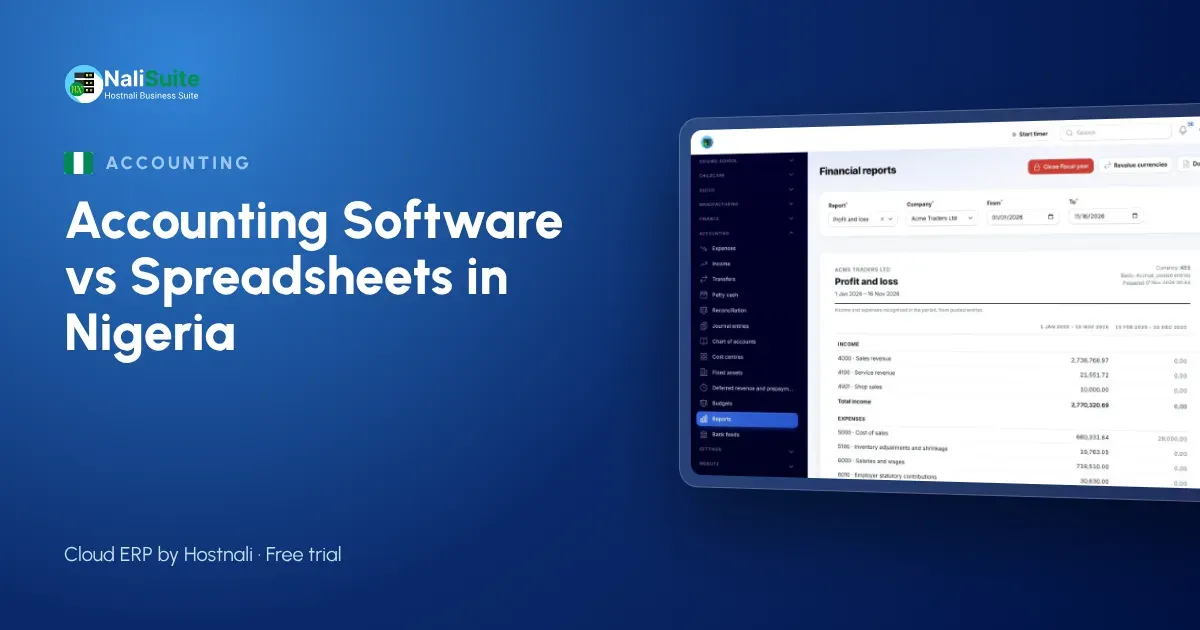
Should a Nigerian SME keep its books in Excel or move to accounting software? There is no single answer for every business, but there is a quick way to decide. Answer the five questions below honestly and the choice usually makes itself.
Question 1: How many bank accounts do you reconcile?
A distributor in Onitsha may receive transfers into three or four accounts with different banks, plus card settlements and POS terminal payouts. In a spreadsheet each statement becomes its own tab, and matching a ₦-denominated transfer with no clear narration to the right customer is slow and error-prone.
If you reconcile one account and a dozen transactions a week, Excel can cope. If you reconcile several accounts and hundreds of lines, software that imports statements and suggests matches will save days every month. NaliSuite’s bank reconciliation does exactly that.
Question 2: Do you charge VAT?
At 7.5%, VAT looks simple until credit notes, discounts and mixed baskets of goods arrive. A formula at the bottom of a sheet calculates VAT on totals; software calculates it on every line, so the figure on each invoice agrees with the figure in your return.
Nigeria is also moving to e-invoicing through the Nigeria Revenue Service, which replaced FIRS. If your business is brought into it, your invoices need to come from a system that can send them. NaliSuite provides the connection for FIRS e-invoicing; you register and use your own credentials.
Question 3: How many people touch the books?
One owner and one file is manageable. Once a sales officer, a store keeper and an accountant are all editing, version clashes begin: two copies of the workbook, two different totals, and an afternoon lost working out which is right.
In software, entries come from the invoices, bills and payments themselves, so there is one set of books rather than several copies of a file. Your accountant can be able to review and close the books with you in NaliSuite.
Question 4: Do you sell on credit?
Credit sales mean receivables, and receivables mean chasing. A spreadsheet can list who owes you, but it cannot send a statement, remind a customer on day 30 or show at a glance which debts are over 90 days. NaliSuite Invoicing does all three, and customers can pay by card or bank transfer from a pay link on the invoice, through providers such as Paystack or Flutterwave connected to your own account. See online payments for how that works.
Question 5: Will you need finance or investors?
Banks and investors ask for management accounts and financial statements. Statements produced from a proper ledger, with every figure traceable to an invoice or bill, are far more convincing than a workbook that only its author can explain.
Scoring your answers
| If you answered… | What it suggests |
|---|---|
| One account, no VAT, one user, cash sales | A spreadsheet is still workable for now |
| Several accounts or VAT | Software will save real time at month-end |
| Several users or credit sales | Software is needed for control and chasing |
| Planning to borrow or raise money | Software, so your statements are credible |
A four-week move
- Week 1: list your customers, suppliers, products and bank accounts, and export them to CSV.
- Week 2: import the lists into the Accounting app and enter opening balances and open invoices.
- Week 3: record new transactions in both places and compare totals daily.
- Week 4: reconcile the month in the software, then archive the workbook.
Coming from QuickBooks, Sage or Tally rather than Excel? The switching guide explains what to export from each.
A second example: an Abuja events company
An events company in Abuja books venues, caterers and equipment for corporate clients, and each event has dozens of costs. In the spreadsheet, costs were listed by month, not by event, so the owner could not say which events actually made money. Deposits received in advance were mixed in with final payments.
Moving to software changed two things. Each supplier bill is recorded against its event, and client deposits are recorded as part payments on the event invoice. At the end of each event, the owner can see its income and costs together. Two events that looked busy turned out to have lost money, and pricing was changed.
Nigerian pitfalls when changing over
- VAT on mixed sales. If you sell both VAT-able and exempt items, set each product up correctly before importing, rather than correcting invoices later.
- Bank charges and stamp duties. Small bank deductions appear on every statement. Create accounts for them so reconciliation balances.
- Withholding tax from customers. Large customers may deduct withholding tax; record the credit notes or certificates so receivables stay correct.
- Several branches, one file. If each branch kept its own sheet, merge customer lists carefully to avoid duplicates.
Frequently asked questions
Is accounting software only for big companies?
No. Plans are priced for small teams, and a single-branch shop gets the same core apps as a large distributor.
Can I still export to Excel?
Yes. Lists of customers, suppliers and products can be exported back to Excel or CSV whenever you need them.
What happens to my old data?
Keep the workbook as an archive. Bring across balances, open invoices and lists, not years of individual lines.
Does it handle naira and dollars?
You can invoice in the customer’s currency and keep your books in naira.
Do I need to stop using Paystack or Flutterwave?
No. You can connect your own payment provider account, and payments received through it are matched to invoices.
Try NaliSuite
If three or more of the questions pointed towards software, NaliSuite is worth a free trial. Plans start at ₦3,125 a month. View the plans.